How words can change your world, with poet, Leah Bailey.

In this fourth episode of season 2 The Mindful Writer, Leah Bailey, talks about the power of words and explores how they can change our perspective.

Before I introduce you, let me update you on my writing journey. Publication day for The Forever Cruise gets closer, and I experience as many highs and lows as a cruise ship on a choppy sea. The paperback is already out, as I wanted to be sure I had copies in time for the launch party on 1st December – which is the day the eBook goes live. 

Highs – I’ve had some wonderful reviews from readers who ordered the paperback, and advanced readers who received a copy of the eBook in exchange for an honest review. 

Lows – I noticed some typos in the paperback and had to correct and re-order for the launch party. What have I learnt from this? I have reviewed my proofing process so that there is less chance this will happen again. Having beaten myself up for not being perfect, I have reflected and concluded that it is okay – we learn from our mistakes. I’ve been charging ahead at a million miles an hour, wearing myself out, and making mistakes. I set high standards for myself, and so, when I fail to meet them, I am tough on myself. I am learning to be kinder to me. To slow down. And to be grateful for where I am now on my writing journey. 

I am looking forward to celebrating the publication of The Forever Cruise with my wonderful readers, friends, and family. It is with their support and friendship that I have been able to write and publish this book.

Sometimes we are so focused on what we have not achieved that we forget to cherish where we are now. 

My guest this week, lives very much in the moment. I found her interview fascinating. So, let me introduce you.

Leah Bailey is a poet, and teacher of English language and literature. In this episode, Leah explains how we use language to:

  • Connect with other people
  • Make sense of our world
  • Express how we are feeling
  • Process thoughts, and emotions.

Leah also shares some practical exercises to write for wellbeing and reads two beautiful poems.
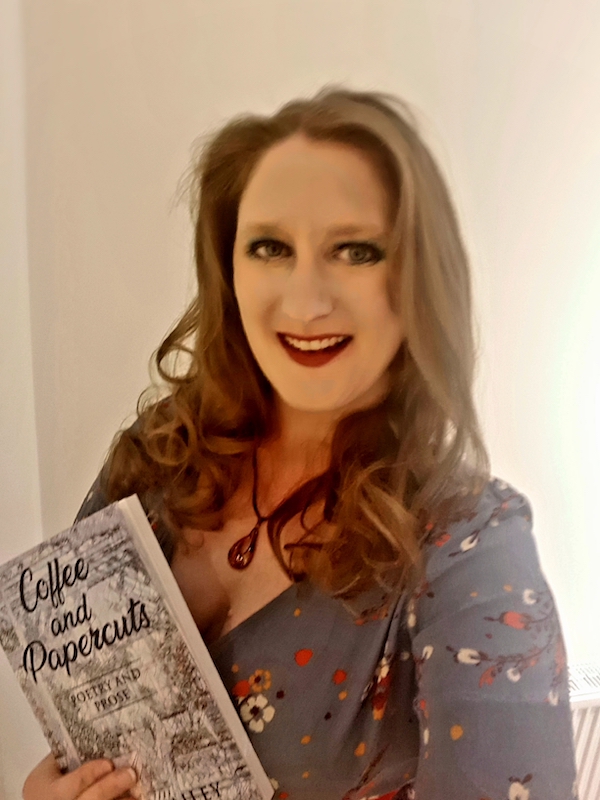
Leah Bailey

Deborah: Hi Leah, I am really pleased to welcome you to the mindful writer podcast. So, before you introduce yourself, and I shall do a bit of an introduction for you, I should just say you are recovering from the cat knocking over your mug of coffee. 

Leah: Yes. Two of my key things for my sanity is my cats and my coffee. But unfortunately, they do sometimes collide. 

Deborah: So welcome. Leah, you are a poet, with three collections of your poems now published, including the most recent, Coffee and Paper Cuts. I love the title of that one. The English language is your passion, and one that you share with others, both as a poet, and a teacher of English language and literature. So, let’s start with why you think it’s important to use the written word to communicate our thoughts and feelings.

Leah: I think that language is how we approach the world. It’s how we think; it’s how we communicate. And so, to be able to understand ourselves, using language, through reflection, and then to be able to communicate our understanding to someone else, connects us to other people: whether the language is our own, or someone else’s. 

I did some travelling recently. And so, you know, when you’re in a country where you don’t speak the language, you have to communicate. And so, you find the words – you find the sentences – you find the capacity, using everything you have to get something across. That is quite important and valuable. 

But language, and the words that we choose to use, can be both helpful and harmful

And so having the right ones, and communicating what we actually want to say, instead of what we think we want to say. Miscommunication, can cause huge problems in terms of language. So, knowing and understanding the right words to use to communicate what you actually mean is vitally important for anybody: adults, teenagers, students, and teachers alike.

Deborah: And that is a skill, isn’t it? I remember my aunt years ago – I overheard a conversation; she was talking to my mum. And she said, ‘Oh, my husband gets so crossed with me, because he says, when we have arguments, you always win because you know, the right things to say, and I don’t have the language or I can’t express myself like you do.’ So, he felt powerless compared to her. 

Sometimes there’s a bit of an imbalance or an inequality, when somebody hasn’t had an education, or they can’t express themselves so well, to actually be heard. So, I wondered how teaching language and working with students, adults and children, and young people, how you can help people to express their emotions.

Leah: Well, it’s important to try and get them to think for themselves, and not just parrot other language that they’ve heard. One of the most important parts of my job is not telling them what to think. Because obviously, that would be me imposing my ideas on them. My language, my words. It’s trying to get them to understand their own responses and their own thoughts, and put those thoughts into words, because all too often, they are just repeating something that they’ve heard in the playground, or just repeating something that they have heard in the classroom, or out in society, or on TV. So, the concept, you know, the concept of trying to get them to express themselves, but making sure that it’s them. Making sure that it’s their own thoughts, and not just the thoughts of someone else that they are copying because they think that that’s in fashion. So, the thing I suggest to all my students is to read as much as possible. It doesn’t have to be classics or poetry or, or even something beyond the fashion magazine. But any reading at all. 

Any reading at all exposes you to more ideas. And the more ideas you have, the easier it is to express your own ideas.

Watching how a great writer does it, or how someone you admire does it, helps you do it better yourself. So, finding language – finding language to be able to suit your own ideas, is vital to being able to argue for yourself, being able to defend yourself, or support yourself.

And all too often people use it to manipulate others just because they’re better at it. So, you know, we know that language has a double-edged sword. It can be used for great, good things: persuading people to step up and do the right thing. And unfortunately, persuading people to engage in horrible things. So, you know, using the power of words is a dangerous tool, but is vital to be able to use yourself.

 Deborah: As you said, at the beginning of your response, words can be used for good or for bad, and they can influence. They’re very powerful.

What about using language to help you understand your feelings, your emotions, and to understand yourself, when you’re in a dark place? How can writing help you to make sense of your world?

Leah: Well, writing for me has always been a kind of therapeutic use – a therapeutic effect. My process for writing is – usually when something occurs to me, or I have an emotion, or a feeling that’s happening, that is intense, especially whether that’s intensely good or intensely bad. But those intense feelings you have inside. My process for writing is to usually write down a single word, or phrase or something that I see in front of me. And that’s where I start. And then I write it by hand, and I just kind of splurge. I don’t worry too much about the technical things. And then when I take the handwritten and type it up, I can start to shape and develop it.

 And for me, especially when it is negative, it’s taking it outside of my head, and putting it onto the page, so that I can look at it and observe it, and deal with it outside of myself. 

So, whether your type of writing is poetry, or prose, or any kind of thing, it’s taking the feelings and trying to find the right words. And then shaping them, and dealing with them, and developing them outside of yourself on the page that I find the most helpful, because then it’s not in a tangle inside your brain. It’s in a defined – it’s online. It’s you know, in letters and words, and punctuation marks, and you can you can deal with it. And then when you have dealt with it, or when you’re satisfied that you understand it, you can shut the book and put it aside. 

Deborah: That’s a really good way of describing it. It’s almost as if you can have a conversation with yourself, because you can get it out. And then, as you say, look at it objectively with fresh eyes. And it’s almost like a dialogue between you and your inner thoughts. Excellent. 

Leah: Hmm. Wrestling with it.

Deborah: We were talking in another conversation we’ve had outside of this, about when a person is in dark place – a person experiencing depression. And they may not understand. How do they understand what’s going on? And how can loved-ones help – understand what’s going on? Because trying to give voice, or to be heard, or to explain – can words help with that? 

Leah: Well, you know, obviously, in that previous conversation we had, you know, I deal with a lot of people who have different types of mental health issues. I myself, have dealt with episodic depression. So, it’s part of that kind of word tangle I said was in my head. 

A lot of times people don’t, who have not experienced any mental health problems, will not understand the experience of it.

So, if you are able to somehow put it into words, that gets them closer to being able to understand the experience of it. But likewise, one of the main problems with things like depression is that there isn’t a reason. Loved ones and people that we are in relationships with, and friendships with, they desperately want to help. But it’s difficult to communicate reasons for something feeling the way it does, when there isn’t a reason. Because a lot of the difficulties with mental health, is that they’re irrational. They are just parts of our brain that are making us feel, and do, and say, things that we wouldn’t necessarily want to if we didn’t feel the way we do. That there’s no source. There’s no reason for it happening. And if you have experienced that, it’s difficult to communicate to someone else that there isn’t a reason. That you just feel the way you do. And so, using writing and using poetry to kind of communicate that helps someone else understand it. 

One of the main purposes for all of my writing is to share experience good and bad: emotions, events, experiences.

To try and connect with someone who might not be good with words, as you said, someone who struggles with knowing words or knowing what to say, it’s helping that person say, ‘Yes, that – that’s what I feel. I’m not alone, thank God. I’m not the only one. Or someone who has never had that experience, to kind of feel it, however briefly, while reading the poem. And think, ‘Oh, my gosh, that’s incredible how that feels.’ or ‘That’s horrible. I wish I could help someone who feels that way.’ So that the concept of shared experience with writing makes it resonate.

I can’t tell you, there’s any number of poems that I’ve talked to with people that I know have read them. Then like that, you know, that made me cry, or that made me laugh, or I saw myself in that. And it’s not that I have anything necessarily special about putting those particular poems out there. 

It is just, from my experience, from my observation, from my reflection, trapped in words and stuck on the page, and shared with someone else. Not just as a relief to me, so that it’s outside me and I can deal with it, but so that they themselves can see it, and know that they are not the only one feeling it and, and have a way of expressing it themselves.

Deborah: I’m glad you said that, because that’s really powerful. And especially to people who might be listening, who live with loved ones who go through depression. I hear so many people say, ‘I don’t know what to say. I don’t know how to help them.’ So that’s really helpful.

Leah: It’s important, you know, when you read these poems, or you read these experiences, or when you listen to people who have experienced it – putting it into words; it’s not about necessarily actively doing something. Just like there isn’t an act of reason that necessarily starts it; there’s not necessarily one trick, or one thing that you can do to help that person other than not give up on them. 

You know, we people who experience depression, have a tendency to push people away and to isolate themselves, either because they feel like they deserve it, or because they don’t want to burden their loved ones in their relationship. They see someone trying to help them, and trying to help them, and trying to help them, and they feel like a burden. That you know, their completely irrational feeling is harming someone that they care about. 

And so, the important thing with a loved one who’s experiencing mental health is simply the effort of trying to understand and not giving up on, you know, that continuing process, as they try to understand themselves, you work with them on that – you go on that trip with them. So that you both learn kind of together and deal with it.

You know, it’s something that I’m quite passionate about – trying to help the students and adults that I work with to be healthy in themselves. With that wellbeing in trying to explore those thoughts and emotions: positive and negative, that come from, from everyday experience. 

Deborah: Thank you. And that leads me to my next question about your writing for wellbeing workshops. You work with adults, and you work with young people. So how does that work? How might somebody who doesn’t consider themselves to be a writer – they’re not going to write a novel, a story, or a poem – but they want to use writing to help them get in touch with their thoughts and feelings? How would they go about that?

Leah: Okay, well, that’s like a two-part answer. And the first one, and the reason I started the workshop, is because we have responsibilities all the time. We have emails to write and reports. And in this – in the academic context – were where I live, essentially, we have to write essays and we have to write stories. And even when we’re writing poetry and creative writing, it’s for a grade or it’s for a parental report, or it’s for an office email. And it doesn’t matter what job you’re in, a lot of the communication that we have to do day to day is our responsibility. And I started the writing for wellbeing workshop simply as an outlet and a one-hour a week outlet for people to just write for fun. To just write whatever’s in their mind, just for the sake of doing it, not for any other purpose, or any other responsibility.

Just to enjoy going through the attic, of their mind and kind of getting it out there without actually having to produce anything, or be anything other than what they want.

So, when I start the workshop, I’ll give you the other answer, which is: I provide stimulus. And so, if you don’t consider yourself a writer, that’s fine, you don’t have to be. The idea of writing for wellbeing is starting with something small.

I have writing prompts that I provide. For me, I have them on my Instagram, once a week. But when I come to the workshop, I have maybe lists of them, and I put them out and people can choose a particular prompt. Or there are tonnes of books that contain writing exercises that you can do. I use one called The Five-Minute writer, which is great, it has like 50 different five-minute exercises. The exercises or the writing prompts are just a start. It’s whatever comes to you from that.

There are ways of doing it using abstract nouns or random words. Like you can almost literally cut up a dictionary, and pick out a word. And then whatever comes to you from that word, that’s what you write about. Fiction, nonfiction, poetry, whatever. And then it doesn’t have to be 100,000 words, it can be 10, or it can be two sides of A4, or it can be whatever it needs to be. But the idea is to just kind of go with it. Whatever Association you have. We hear it all the time; people hear a song on the radio and it reminds them of a memory. Or they hear a certain phrase or quote from the film or TV show that they’ve seen, and it reminds them of something else, or the moment. So, that’s the kind of thing we’re talking about. You start with a writing prompt, or a word or an idea, and whatever is associated with that, that’s where you start developing it. 

The next step obviously, could be a picture. When we take photographs, we don’t take photographs of everything and anything. I mean, you know, I do, because I’m weird. But I mean like observation of what’s around you – what’s important. So, when you are thinking about taking a picture, you kind of frame it. You look at it; you get the right angle; you get the right content in the photograph; it’s the same with writing. There’s information around us all the time – stimulation. I’m sitting in a room with the fan going. I can hear the buzzing of the fan. My cat is sneaking around under the bed waiting to destroy another coffee cup. The light outside is a particular threatening to rain kind of look. And I’m in just one moment here, feeling those things: temperature wise, topical wise. It doesn’t have to be a great metaphor of our time. It can just be what your senses feel around you. 

Same with a photograph. When you take a photograph, it’s because you want to remember it. The whatever,that is in the photograph, is something that you want to remember. So, you can look at the photograph and do that same sort of sensory input. What temperature was it? What was the weather like? What were you feeling that made you want to take the photograph? Why do you want to remember it? Why is it important to you? Has that memory changed since you took the photograph? Does the feeling change since you took the photograph? So, all of those observational skills of what’s coming at us all the time is fodder for writing. You’ve got to do it. It’s being aware of what’s around you, and then putting it into words. And that’s just the external stuff. Once you start to develop that you can reflect on it, and turn it on the inside of what that stimulus on the outside does to your brain.

Deborah: And how does it help with health and wellbeing?

Leah: Being aware of what affects you is extremely important. Whether that’s noticing that every time it rains, you get a certain feeling. Or if you have a favourite coat, or a favourite bag, or every time you wear a certain shirt it reminds you of a certain person, or a certain day when you wore it before.

 So, that awareness of what stimulates those feelings is extremely healthy because then you can start to pick and choose what makes you feel good.

And what makes you feel more yourself; what makes you feel your best self, and start to discard or minimise the things that don’t make you feel good, or don’t make you feel yourself. So, by extending our awareness, and for our observational skills in order to write about them, you start to notice things you might not have noticed before. And in noticing them decide whether they are beneficial or healthy, or includes your wellbeing. If you know that a particular – if you start to write about a particular voice, or a particular stimulus outside of yourself, that is not very healthy, not very helpful you can start to minimise it, or avoid it, or detract from it, to improve your wellbeing. And then, over time, the observation – the more you observe, the more you understand, the easier it is for you to decide what you keep inside yourself.

Deborah: Excellent. I think in addition to getting a greater self-awareness through writing, the relaxation of writing – going to a quiet still place, it’s quite meditative, isn’t it?

Leah: Yes, I do write in quiet places. Sometimes I do find that nice, quiet still place. When we have the workshop, it’s usually after school in a quiet classroom. We don’t always interact. I give out the stimulus, which they’re free to ignore. And then they just write and then people share, but they don’t have to share to get feedback. So, that nice quiet space.

I also write in the noisy bar, because that’s very stimulus heavy as well. So, I think both. I’ve met loads of writers and they all say they all have their place where they go writing. So, I think that it can be just as fun in a noisy bar as it can be a quiet classroom.

Deborah: But it’s the going there. In fact, that leads well into the poem that I hope you’re going to read. Because in this poem, when you wrote it, you were in a public place but you went very much inward to write it. So, it’s a good example. I shall let you introduce it. 

Leah: Okay, so this is from my first book between Hindsight and Foresight, which is best of all the poetry I’d written from the time I was 14 Until I was 38. So, it spans a whole wide range of feelings and emotions and experiences in one volume.

This particular poem was written the first time I lived on my own – basically in my entire life. I’d never lived on my own, it was family or partners or uni. But this was the first time I’d lived on my own and I decided to go out to dinner, even though I was on my own. And so, the poem follows that process and it’s one it’s one of my favourites to use as an example because it was a sneaky poem. I thought it was going to be about one thing, and it turned out to be about something completely different.

So, it’s called: Define Alone 
Image by Umut Yıldız from Pixabay

Define Alone

Is it an empty restaurant

with kind staff who smile,

and remove the other set

so you don’t feel alone?

Is it the abandoned

and crumbling petrol station

with an exit sign the only

legible sign

through flimsy wire fence?

Is it the dim twilight

painting pastel colours

as your steps echo

on cracking pavement

one set?

Is it the lone voice

of your nature

turning thoughts

like straw into gold

giving you someone

to talk to?

Is it the single flame

burning on the tealight

next to your single

glass of wine?

Is it an empty night

staring out a window

which frames a twisted,

ivy covered tree

in the gathering night

with emerging stars?

Is it closing your eyes

and wiggling your toes

in the wet sand

feeling the wash

of the grit begin to

sink you

in the last warmth

of summer?

Is it a single touch

along the jawline

thoughtful

gentle

provoking thoughts

of it being

someone else’s

hand?

Is it a strand

of long hair

in your eye

shifting the light

into a forested

shadow?

Is it an empty chair,

staring,

sitting across

the table

wanting to be

filled?

There is so much that

can seem alone

but alone… is not

the same,

as lonely…

I relax into the empty

the abandoned and crumbled

the dim twilight

the turning thoughts

the single flame

the single glass

the wooden frame

the twisted tree

the closed eyes

the sinking sand

the last warmth

the single touch

the long hair

the empty chair.

I listen to the alone…

and am content.

By Leah Bailey.

Deborah: Lovely. It gives me shivers. It is beautiful. Tell us about what you thought it was going to be about, and what it ended up being about.

Leah: Well, this happened obviously, like I said, when I was living alone for the first time, but it was like a really dramatic change in my life. I’d never lived on my own. And so, it became,

it became … I thought it was going to be an exploration of me being lonely. And you know, how it felt to be lonely, or how it felt to be on my own for the first time. And

instead, it turned into kind of a – almost a mantra of realisation that just because I was alone, didn’t necessarily mean that I had to feel lonely. That I could still enjoy the twilight. I could enjoy a night out. I could, you know, just listen to the quiet, and the echoes, and the reflection, and have it not be negative, to be on my own. 

So I started the poem thinking that it was going to be an exploration of how I felt being so lonely. And it turned out to be like, well, no, you’re alone – not the same. And it was very sneaky. Poems – ideas are not always in the charge of the writer. Sometimes they take over. And they’re like, No, no, this is this is what you want to write about. This is what you’re thinking; not what you thought that was.

Deborah: What it says to me, is that you’d gone out with one feeling – feeling like, I’m going to this restaurant on my own; I’m going to feel lonely. And this is what I mean about the process of the writing, because you were very much in the moment. You were picking up all the sensory cues around you, as you wrote them down. You were very much in the moment, and that enabled you to go inward. And as you went inward, you found that sense of inner peace, and the reassurance within that this is okay. So that’s where I think that writing can be quite meditative, and help you connect with your inner self. 

Leah: Yes.

Deborah: It demonstrates this beautifully. 

Leah: Yes, and as we were saying in another conversation about when we are in relationships. 

When we are with other people – family, or partners, or friends – we change. We have different facets of ourselves, and we become that person that they relate to.

But when we’re on our own, the only person we have to relate to is ourselves. And so, the mirrors, the bouncing off of who we actually are, and how we actually are and how well we are or, our wellbeing, or how we are feeling. We have nothing to bounce off of when we’re by ourselves. 

And so, within relationships: that is who we are. And it’s not always bad to be the person within the relationship. But our identity separate from our relationships, is also important to explore, which is where that kind of went. Define Alone is how I relate to myself when there’s only me there.

Deborah: I find that interesting, because I’ve been married to my husband for 38 years; I’ve been a mother for 33 years; and sometimes when I’m meditating, I just I just go back to who I was, before I was a mother, before I was a wife, to connect with my younger self. Because sometimes I feel that I can see myself so much through their eyes and their impressions of me. 

When you’ve got a partner of many, many years, you kind of partly absorb part of them, as you do with your parents. Since my mother died, I can hear her voice in my head all the time with her views on things. I think all your loved ones – you get all of their noises in your head. And sometimes, finding that quiet still place that is you, is quite hard. Because you love them all, and your relationships with them are important, but there’s also a part of you that is uniquely you. And we lose sight of that sometimes, don’t we?

 Leah: Sometimes, and it’s important to get back to it. And that is another benefit for the wellbeing of the writing, because 

if you do write over time, you can then revisit that writing and remind yourself of a good thing. Or you can remind yourself of a negative experience you had and realise how strong you are to have overcome it when you’ve when you’ve gone past it.

So, by pinning it to the page, you’re not just dealing with it at the time for your wellbeing. But also, later on when you go back and you look at these things and you remember those pleasant experiences, and you relive those pleasant experiences, and you relive the darker ones realising how strong you are to have gotten past. And it’s like, you know, so it puts everything in perspective if you can look at it over time. So, it helps you at the time, and it helps you later to revisit it.

Deborah: That’s great. I’m going to ask you to read another poem, but this time, I would like you to read a poem that has influenced you. Because you were saying that sometimes you read a poem, which means that you don’t feel so alone. So, I’m interested in the receiving of poetry and hearing, as well as the … the two-way process of the words coming from you and receiving. So, I’m going to say goodbye to you in a moment but before we do that, please could you say something about receiving poetry – the other part of the two-way process?

Leah: Obviously, I read a lot because I am a teacher, and so I read constantly. My preference for reading is pre 1900 poetry and things like that. I do read some modern poetry. There’s a series published by Bloodaxe called, Staying Alive: Being Human, which is all very modern poetry written in the last one hundred years. It is very good – encompassing many, many topics. It’s good to dip into and dip out of when you need that kind of exploration. 

The poem I want to read to you comes from an anthology that a friend gave me as a present when I was a teenager because she knows I love poetry. I love exploring other people’s feelings and seeing if it’s like, or unlike, my own feelings. It helps me to express. This particular poem that I’m going to read to you is by Grace Stricker Dawson. I’ve used it many times to express to other people who I feel that they have helped me, because the experience is similar. So, If I don’t have the words someone else might – kinda thing.

Deborah: Thank you Leah. I am going to say goodbye to you now, and then we will close the show with the poem you are about to read. 

Leah: Okay. Thank you very much for having me.
Image by Pexels from Pixabay

Leah reads: 

To a Friend

by Grace Stricker Dawson

YOU ENTERED my life in a casual way, 
And saw at a glance what I needed; 
There were others who passed me or met me each day, 
But never a one of them heeded. 
Perhaps you were thinking of other folks more, 
Or chance simply seemed to decree it; 
I know there were many such chances before, 
But the others — well, they didn’t see it. 

You said just the thing that I wished you would say, 
And you made me believe that you meant it; 
I held up my head in the old gallant way, 
And resolved you should never repent it. 
There are times when encouragement means such a lot, 
And a word is enough to convey it; 
There were others who could have, as easy as not — 
But, just the same, they didn’t say it. 

There may have been someone who could have done more 
To help me along, though I doubt it; 
What I needed was cheering, and always before 
They had let me plod onward without it. 
You helped to refashion the dream of my heart, 
And made me turn eagerly to it; 
There were others who might have (I question that part) — 
But, after all, they didn’t do it!

A moving poem to end this episode. A reminder to be kind, and not just to others but to yourself. Would you speak to your best friend the way that you talk to yourself in your head? Our work for today – to love ourselves and to be the person described in this poem in the way that we take care of us. If you find it hard – think of the person who loves/loved you most and imagine what they would say to you. Feel their love.

So, until next time … look after your beautiful self, and trust the journey.
You can find all episodes of The Mindful Writer podcast here: https://themindfulwriter.buzzsprout.com

Don’t forget to subscribe so you don’t miss any episodes.
How to keep grounded and be courageous with poet Ingrid Wilson

In this 4th episode of The Mindful Writer, poet Ingrid Wilson reads a few of my favourite poems from her collection, and talks to me about becoming forty. Before I introduce Ingrid, let me update you on my writing journey.

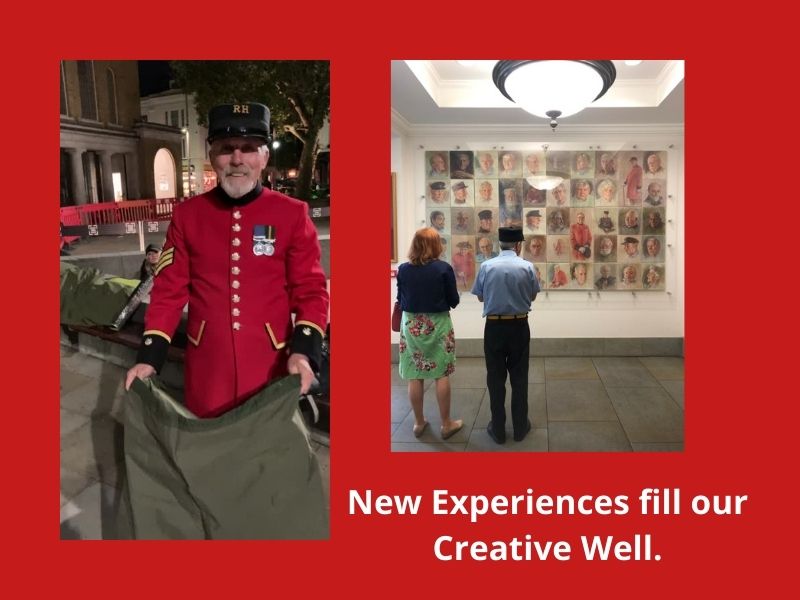
 We are enjoying a spell of warm weather in the UK at the time of writing this. Do you find it difficult to keep up a writing routine when the outdoor beckons? Although it’s many years since I lived by the academic year, I always find the need to have a break in August. Slowing down in the summer months feels right to me. I believe that being part of nature we should listen to our natural rhythm and accept the ebbs and flows of creativity. I have been enjoying what Julia Cameron, in her book, The Artists’ Way, describes as filling my creative well. An outing to The Royal Hospital on the day of The Chelsea Flower Show has filled my cup with story ideas. A Chelsea Pensioner, who I met last October when I was sleeping on the street for one night to raise funds and awareness for homelessness, invited me to visit him at The Royal Hospital for a private tour. The  day following that inspiring visit, I wrote the synopsis for two novels. 


Left: Chelsea Pensioner Alan Rutter shares the pavement with me when we bed down for the night in October. Right: The Royal Hospital admiring a mural of pensioner’s portraits. A few of these faces will influence characters in a future novel.

So, enjoy the summer. Experience new things, and fill your head with ideas. I would love to hear what you are up to: how you are spending this summer, and how you self-care to enjoy the rewards of each season. Now, to the interview.

Ingrid Wilson is author of the poetry collection 40 Poems at 40 At the time of this episode going live Ingrid has been busy preparing Wounds I healed: The Poetry of Strong Women for publication day on 18th June 2022 with the editorial expertise of Amazon #1 bestselling poet Gabriela Marie Milton.

In this week’s episode Ingrid explains:

  • How she keeps grounded when experiencing uncertainty and change
  • How she found the courage to pursue her dream of being a fulltime writer
  • How she is using her unique combination of talent, skills, and experience to make a difference in this world.

Ingrid Willson

You can listen to the podcast here:

Episode Four How to feel grounded with poet Ingrid Wilson

or, read the transcript below.

Deborah: Welcome Ingrid. I’m really excited to be interviewing you for the mindful writer because I have followed your blog. And I know you followed mine. We’ve had some really interesting chats online over the last couple of years, and I know you’re a like-minded soul. You’re very aware of your spiritual and personal growth journey.

 I’m going to introduce Ingrid by giving a quote from a review of her recently published poetry collection, 40 poems at 40, which is exactly what it says. It’s 40 poems that you wrote to commemorate your 40th birthday. This review came from Gabriella, Maria Milton, and this is what she said.  ‘40 poems at 40 is the manifesto of an extremely intelligent and talented woman unafraid to explore her past and her inner world.’

And she went on to say, ‘A woman who knows how to ask questions about the real meaning of life. A woman who does not mince words and does not submit to stereotypes’. I think that’s wonderful review. And what wonderful things to be said about you. I absolutely agree with her. So, I’m really excited to welcome you Ingrid.

Let’s start by asking you, what inspired you to publish a collection of poems to commemorate your 40th birthday?

Ingrid: I’m going to read a short part from the introduction to the book because it explains it quite well. In the introduction to 40 poems at 40 I’ve written: I’m publishing these short and highly personal poetry collection on the occasion of my 40th birthday as I feel in some way that this milestone marks a watershed between the faltering and unsure steps of youth through the years of self-doubt, and even at times, self-loathing into a period of self-acceptance and quiet competence. A period of reflection, serenity, and gratitude, balanced as ever with hard work.

Deborah: Amazing. Forty seems a long while ago to me that I’m now 62, but I do remember it felt like a watershed for me. It is a time when you have had lots of experience and you’re looking forward. So, can you tell us a little bit about some of the major things in your life that have happened that have brought you to forty?

Ingrid: Oh, well, there’s been a lot. I mean I experienced bereavement early on because I lost my mom when I was eight. So, that will have played a big part – well it’s had a huge impact on my life, and my development. Not all of it negative. I mean, I’ve grown and learned a lot through my experience of processing grief.

Then, I moved around a lot as I think you mentioned. I’ve lived in lots of different parts of the UK. I’ve lived in Manchester, Newcastle, London for a long time. And then, with my family, I moved abroad. We lived in Barcelona. We lived in Malacca. We lived in Slovenia and now I’m back in my hometown, back in the UK, in the north of England. So, that has really shaped this journey:  the travel, the emotional experiences. And I have two beautiful children as well, which of course has shaped my experience and brought me to where I am now. I’ve tried to get all of this into the book in one way or another. 

Deborah: So, adjusting to live in different countries. I mean, that’s, you have to be quite courageous to have that kind of upheaval. How did you find the adjusting? How were you with language and culture and integrating into communities?

Ingrid: I found it very interesting. It was certainly challenging. When I arrived in Spain, I didn’t speak very much Spanish at all, but I had to learn fast because I put my son into school and the Spanish school. Then I became pregnant with my second son and I was having to talk to doctors in Spanish. So, I just threw myself into that and really focused and spent a lot of time practicing with Apps and practicing speaking. That helped me to integrate up to a point, but I still did feel like a foreigner for a long time until I started to work. When I went to work in Spain, I got a lot better at the language and I felt more that I was integrated. Slovenia it was totally different. I could already speak Slovenian coming to live there, I felt a really huge culture shock more so than when I went to Spain. Perhaps because of the pandemic and the circumstances in which we moved, but I found it harder to adapt to life there overall, lots of challenges. But I had to keep grounded, you know, keep doing my yoga, spiritual affirmations. And of course, the writing. That always helps keep me grounded. 

Deborah: Let’s go on to talk about being grounded because you take a lot of inspiration from nature in your poetry, which is one of the things I love about your poetry. And I know the environment’s very important to you. You recently hosted a community assembly on the climate and ecological crisis. So, does nature help you to feel grounded too?

Ingrid: Definitely nature. Being out in nature is very therapeutic to me. If I’m going through a difficult time personally, or if outside world events are getting me down, I head out to the countryside. I’ve got the Lake District on my doorstep now, which is a place I really love. And I like to go to the quiet places where there aren’t a lot of tourists around and just listen to the sounds of nature and take in the sights and smells.

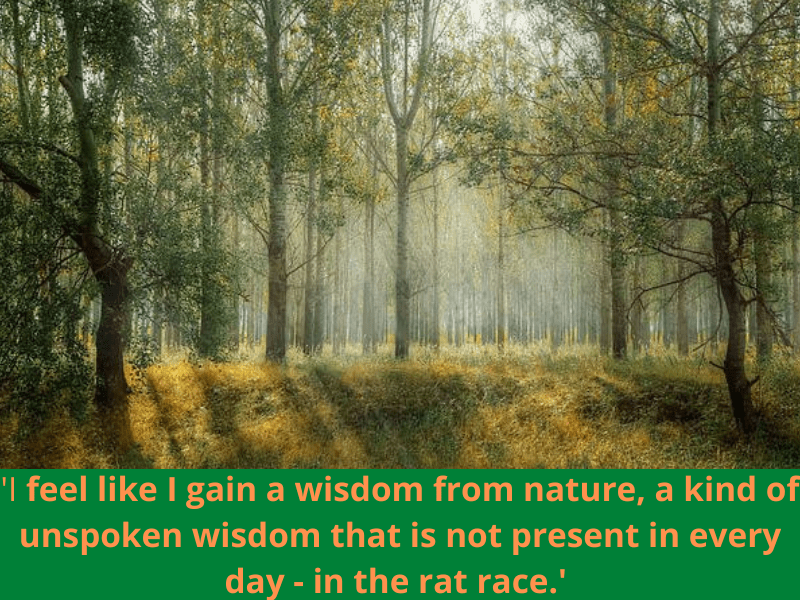
I feel like I gain a wisdom from nature, a kind of unspoken wisdom that is not present in every day – in the rat race. You know, when you go into the shops?  It leaves me quite cold and so just to feel whole again, heading out into nature really helps with that. Also, the seaside. I’ve lived by the sea several times in my life I’m lucky to say. That inspires me too. It does feature a lot in my poetry. 

Deborah: Absolutely. I feel exactly the same and I don’t know about you, but I would choose where I live by making sure I have those things around me. For me. It’s the sea. I can be walking by the sea within five minutes from leaving home. I can walk to the sea. I couldn’t imagine not living near the sea. I think I’d be claustrophobic if I was too far inland. I like to look out over the edge and breathe the fresh air.

 But not everybody who’s listening will have the countryside or sea around them. But even if you can find some open, or green space will make a difference.

Ingrid: I’ve lived in London, you know, right in the middle of the city and just to go to the park or to the river will have a similar effect for me. Nature’s always bursting through wherever you are. It always finds a way through however much concrete we put down, or buildings we put up. It’s always there. We just need to know how to find it. 

Deborah: Absolutely. I find it always just fills me with awe and makes you feel that you are connected, and part of something much greater and bigger. To be grounded is really to feel connected with your body and the earth, isn’t it? Sometimes we can get so caught up in what I call the thought goblins, all the noise that goes on in our head, and that’s when we start to feel ungrounded. We need to take time to bring ourselves back into our body, the earth, and feel connected so that we ‘ve got a clear and calm mind. And I think it’s particularly difficult at this time. We’ve got so many pressures going on in the world haven’t we? First of all, we had the pandemic, and then the things going on in Ukraine and across the world. It’s such an unsettling time for us all. I think  it’s really important people know how to feel grounded. 

There’s nature. There’s meditation. You and I both are strong advocates for the benefits of meditation, aren’t we? Do you try to do a daily practice? 

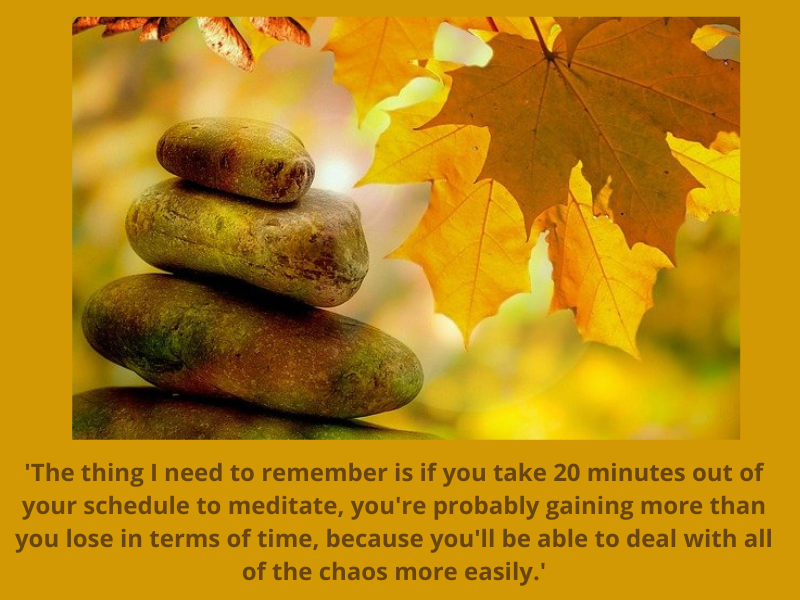
Ingrid:  I do. I’ve been not been keeping it as regularly as I should, and I can feel when it, when I’ve missed out too much. I was in the habit during the pandemic of spending at least 20 minutes a day. Now life’s gone a bit more back to normal, things are more hectic. I can find myself missing out on the practice, but it’s always beneficial. You’re not actually losing time. The thing I need to remember is if you take 20 minutes out of your schedule to meditate, you’re probably gaining more than you lose in terms of time, because you’ll be able to deal with all of the chaos more easily. So I do try to keep up the practice. 

Deborah: Absolutely. It’s like putting some petrol in your engine or oil (I’m not very good on technical things), but it’s filling up and recharging, so that you can cope with what life throws at you. And also, you’re more effective because you have more clarity of mind so you can see your path better. 

Ingrid: Yeah. It’s like seeing the woods for the trees. Isn’t it? 

Deborah: Absolutely. So, you have had an interesting life traveling around the globe, as you say. Have you always had a strong sense of purpose? 
 
Ingrid: It’s interesting you should ask. As a child I did. I always enjoyed writing.  Especially I could relate to poetry and I would recite it and learn it and write my own poems. And I always felt that I would do that. You know, that would be my, my life purpose, but then kind of real life, if you can call it that, got in the way. I went away to study at university and then your kind of shoe horned into ‘You’ve got to have a career now.’ And I didn’t really know what to do, or how to have a life as a writer or a poet. So, you know, I took a day job. Like most people do, you know, got bills to pay and all that kind of thing. And then I wanted to have a family and I sort of drifted away from it a bit. I didn’t stop writing altogether, but with the pressures of everyday life, it kind of went by the wayside until really the birth of my second son brought back that focus. I really felt that now I need to take this seriously, or I’ll just live out my life and do the things that everybody does, but I will not be true to myself unless I do something with writing. And that’s when I really started writing again in earnest. And then with the pandemic and I took redundancy and I started to treat my writing as my profession at that point.
 
And I’ve just been growing from that point. It is hugely satisfying. It’s got a lot of challenging challenges, but I certainly feel I’m fulfilling a purpose that I’ve always had now by doing that. 
 
Deborah: You’re giving a gift to so many others who can read your poems and get so much from it. So, I’m going to get you to pause there and ask you to read one of your poems. Can you read, Points North? I picked out a few that I particularly love, but this for me struck a chord about sense of purpose. 
 
Ingrid: Thank you. 
 

Points North

Wheels in motion and the wind 

whips around behind my ears 

at the nape of my neck 

Deborah: I love that. I think we all have, I believe, a purpose. What comes together with our unique contribution of attributes. You know, our knowledge, our networks, experience, talents, all the things that make us who we are. I always believe it’s been put there because we have a unique purpose to fulfill in our life.

I’ve had a sense of that since I was seven years old. I remember saying to my mum, I must’ve heard Bible reading or something at my school. It must have been about everyone having a purpose. And I said to her, ‘I don’t know what my purpose is. I don’t know what I’m here for.’ And my mother just sort of told me to go to sleep and not to be so silly, but it plagued me from seven years old, until I grasped what it was.

Have you always had a sense of purpose in your head, apart from writing? Maybe about the connections you make with nature and sharing that with others? Or was it just a sort of innate need to write? 

in a subtle caress

 and I know I’m being propelled 

along a river of life 

whose course and motion 

I do not pretend to understand

sometimes I like it when the waters 

speed me down towards a sea 

sunless and sighing

till the cloud breaks 

and I see 

the sky is crying 

and at sundown 

out come all the thousand stars 

and I can name the constellations 

in this hemisphere 

at any time of year 

there is always the Plough

above, or the Big Dipper 

and at its tip, Polaris 

The Pole Star 

Points North. 

And so I have my fixed 

celestial compass 

though I do not 

always understand the path

or the trajectory 

I know well my own 

portion of the sky, 

the earth below, above only the heavens 

and 

Points North.

Wilson, Ingrid. 40 Poems at 40 (pp. 35-36). Experiments in Fiction. Kindle Edition.

/

Deborah: I love that. I think we all have, I believe, a purpose. What comes together with our unique contribution of attributes. You know, our knowledge, our networks, experience, talents, all the things that make us who we are. I always believe it’s been put there because we have a unique purpose to fulfill in our life.

I’ve had a sense of that since I was seven years old. I remember saying to my mum, I must’ve heard Bible reading or something at my school. It must have been about everyone having a purpose. And I said to her, ‘I don’t know what my purpose is. I don’t know what I’m here for.’ And my mother just sort of told me to go to sleep and not to be so silly, but it plagued me from seven years old, until I grasped what it was.

Have you always had a sense of purpose in your head, apart from writing? Maybe about the connections you make with nature and sharing that with others? Or was it just a sort of innate need to write? 

Coutesy of Pixabay

Ingrid: I think it was the writing first because the connection with nature, although it was always there, I didn’t realize it or appreciate it so much at that age. It’s something I’ve grown into. But the writing, that was always a burning thing in me. I kept lots of diaries when I was a teenager, you know? I would write pages and pages not to share. I just have this need to write and yeah, that’s always been with me. I went off to explore different things I would like to do. I love music and I went through wanting be a singer for a while, you know, like, like you do when you’re a teenager and acting, I wanted to be an actress. But really it was the, the writing that I would always come back to. It’s nice to have that. 

I find it interesting that in the poem, Points North; when I wrote it, I was in Slovenia, having just moved from Spain and feeling a bit dislocated. And then I ended up coming back to the north of England. So, I find it interesting that that poems kind of prescient in a way now looking back.

Deborah: Yes. When you’re going through life, because we all have these periods where we feel it as if we’re losing direction, what do you use to help you set your direction to have to have that sense of you’re on the right path?

Ingrid: The few things that we mentioned meditation. Yoga, which to me goes hand in hand with meditation. Just to help me keep my focus on my balance. The writing as well, because I try to keep that going whatever’s happening. However, chaotic my life might be at a particular point. I will keep writing the poetry and it might change a lot in subject and tone and form.

But the thing that keeps me grounded is just the act of doing it and keeping it going through whatever’s happening around, stay clear, headed and focused. I think. 

Deborah: Excellent. I say to people who perhaps are in an earlier stage of their life and have lost direction, or don’t feel they have a sense of purpose – you probably say this to your boys, I always said it to my daughter, when she was growing up: Do what you love. If you do what you love, you’ll be good at it. And if you’re good at it, you’ll succeed at it, because that is the seed that’s been sown in your heart. That seed of desire that is there for you to nurture.

Because that will give you an idea about what your purpose is. And I think, when you get  excited about something, and you get lots of energy, that’s telling you that you’re on the right path. So, when I was younger and I would have a look at a job, somebody said to me, Does it make your heart sink or sing? I would always then test out how does that make me feel? Do I think, oh no, or do I think yay? And you know, that feeling when something really excites you?  For me, I just have to go and run because I just get woosh! All this energy. And for me, that buzz of energy is – You’re on the right path. 

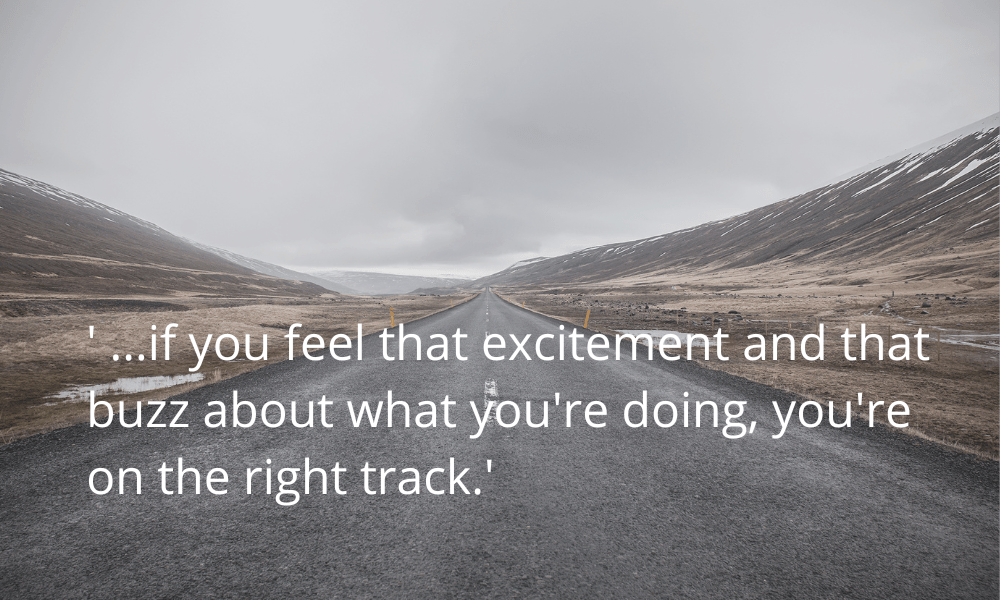
Ingrid: Oh, yes, I can really identify this. It was just funny when you say about looking at the jobs, because when I used to look at the job page in the paper, my heart was just constantly sinking. Whereas now, when I get up and my job is, you know, to write a poem, to work with other writers putting books together, launching creative projects, that really gives me a buzz. And it’s great advice if you feel that excitement and that buzz about what you’re doing, you’re on the right track. 

Deborah: Even if you think, ‘It’s impractical. I’m not earning money,’ or comparing yourself to others, or ‘This isn’t the route I thought I would take,’ ignore that and listen to that inner energy, because that’s your soul telling you which path you’re on. You’re on the right path.

Ingrid: You have to be quite brave to do that and ignore the pressure and what other people think. You just have to. How else, how else can you do it? You have to put yourself out there and believe in what you’re doing. Yeah.

Deborah: Absolutely. We’ve talked a little bit about nature. I didn’t hear what happened about the community assembly on the climate. I’m really interested in that. How did that go? 

Ingrid: Yes, I was awarded some funding to hold a community assembly – to get a group of people together and discuss, you know, the best ways to meet the challenges of the climate and ecological crisis.

So, what we could practically do about it. Unfortunately, I couldn’t get enough people to come along to a Zoom session and discuss this because it was quite a long time. It was supposed to be held over three hours and who wants to spend three hours on these things, but to me it was very important, I’d been given a chance to add my voice. I’m always talking about, we need to do more about this crisis and I had a chance to add my voice to where it might be heard. So, I held it as a poetry prompt in the end. I write for a forum called Earthweal, where we write a lot of eco poetry and we write about the climate crisis. So, I invited people to write poems about how they would address the climate crisis and biodiversity crisis. I posed the questions that I was asked to put into the community assembly as a poetry prompt, just to see what came out of it. And I did get a good response. Then I collated it and sent it to the Global Assembly which does get fed back to some kind of global panel on climate change. Whether it makes a huge difference? I mean, it’s a drop in the ocean, but I feel it’s important to add your voice wherever you. 

Deborah: That’s amazing. I really love the way that you brought together the poetry and how you enabled people to have voice using that media.

That’s amazing. And that’s something that only you could do, that is using your unique contribution, your attributes, your skills, your experience, your network, to do something that only you could do in that way, which is amazing. And it does make a difference. 

Ingrid: Well, you have to do what you can with, with the tools you have.

Deborah: Amazing. And that brings me to another poem I’d love you to read. We started by talking about the sea. I like to go for a walk by the sea pretty much every day. It is where I do my best thinking and meditation. And this really spoke to me. So, can you read to us You and Me Sea?

Ingrid: Yes.

You and Me, Sea – A Love Song 

Ain’t it just like you and me, Sea 

when we dance together, 

I barefoot on the sand, you 

lapping at my toes? 

Ain’t it just like we’re two parts of 

the same whole: 

I was born of you, and you 

bring me to life once more? 

Ain’t it just like you and me, Sea? 

And we’ve always been together 

dancing a saline tango in the sun. 

Ain’t it just like you and me, Sea? 

When I hit stormy weather 

on your shore I’ll wind up, by the wild 

winds 

flung. 

Say, it’s just like you and me, Sea;

I can hear you calling: 

your echo fills my silent afternoon. 

And that was all I wanted to say, Sea: 

When I’m far away from you 

I feel your surge in me which swells into 

a tide to take me home.

Wilson, Ingrid. 40 Poems at 40 (p. 41). Experiments in Fiction. Kindle Edition.

Deborah: Beautiful. Love that. I’m going to give a link in the show notes for your book Poems at 40, so other people can appreciate and enjoy them as much as me, hopefully. And I’m going to get myself a paperback because I just want to have it by me so I can keep on referring to it. It’s a book you have to have as a paperback. I think. You’ve got two beautiful boys. One of them is a poet himself. Isn’t he? 

Ingrid: The older one? Eight. Yeah. They both liked writing so, I think they pick up on what I do and, and they’re inspired by it, which is great to see. I hope they keep that going. 

Deborah: Lovely. How on earth do you juggle your time, especially when you were working as well, with two boys, and keeping up your writing, and working? How did you manage that?

Ingrid: Good question. When I was working – if I was working full-time the writing went by the wayside. So, that’s why I decided to change and make writing my full-time job. So, nowadays I tend to get up very early. I’ll often get up about 5:00 AM. That’s when I have my creative ideas. It’s when the muse is with me. When I write my poetry, I love that silence when everyone else is asleep and you can just hear the birds sing. I sit and do my creative work at that point. And that gets my head in the right place for the day. And then I’ll do the school run and the things I need to do, housework, whatever.

Then I’ll come back and do the more practical side of the writing job: emails, responding to comments on blog, putting work together. The project management side I do later. But the creative work comes first. And that’s how I most often start my day. So, I love to get the day started off in that way, but there is a lot of juggling and I try to make sure I have time for the boys and we, you know, read stories together and go on adventures together at weekends and whenever we can. So, balance is really important. In a way I tend to push myself very hard, and sometimes I don’t take enough time for myself to just relax. I try to put that in as well. Otherwise, I’m in danger of burning myself out. 

Deborah: Absolutely. Yes. It’s a fine balance isn’t it between work, self-care, and giving quality time to your loved ones?

Ingrid: Yep. It can be done, but you have to keep everything in balance.

Deborah:  It sounds like me. I tick them all off in my head. I allocate time. That’s my quality time there. That’s my writing time. I schedule my time. I don’t tell anybody else, but I do.  You probably do the same thing.

Ingrid: Yes. And I’ve had to let go of the idea of things like housework ever being done. It’s just always in the process of being done. It’s like a flow. And if I can manage the flow and stay on top of that, that’s fine. Other things get done. Like a book can be finished and put out, but the laundry is never done. It’s always just been done. And I’m okay with that. Now I used to think I had to get it done, but now I just go with the flow. And that helps me to be able to do other things as well. So yeah, something has to go. You can’t do everything. You would drive yourself crazy if you tried to? 

Deborah: Absolutely. I would like you to read Poem for my children, which is another beautiful one.

Ingrid: 

Poem for My Children 

Let not my words die with me 

after all is said and done 

I dedicate these words to you, 

continue on alone. 

Let not my words die with me 

at the closing of my day: 

they’re all I ever had to give 

and now I cannot stay. 

Let not my words die with me, 

let them linger in the light 

of eventide, e’en as I fade 

into the darkling night. 

Let not my words die with me 

and I cannot be afraid 

that I am leaving you alone 

with too much left unsaid.

But let my words live with you 

let them echo down the years, 

let them resound and comfort you 

when I’m no longer near.

Wilson, Ingrid. 40 Poems at 40 (p. 24). Experiments in Fiction. Kindle Edition.

Courtesy Shanghaistoneman Pixabay

Deborah: That makes me cry. I cried when I read it and I cried when you read it out. It’s very, very good.

Ingrid: I knew I was onto something cause it made me cry when I wrote it. So yeah, it’s an emotional poem that one.

Deborah: It’s beautiful. Do you think that’s one of the reasons writers write? To leave a legacy?

Ingrid: Yes. I think the first reason writers write is because it’s in them and you just have to. For me, it’s like, I don’t really have a choice. It’s part of me and I need to do it. And then I thought, some things you just write for yourself, like a diary, or if, you know, you make a journal because something’s upset you and that’s very personal type of writing. But then I think, yeah, as writers we do also like to write for an audience and we like to have at work read. Certainly, my poems. I want to share them. I put them on the blog and sometimes I think I should hold these back so I can include them in a book. I write them to be read, and I always try to keep my readers in mind as well as me.

I’ve wanted to have a direct, emotional impact. I like word play. And I don’t really like to use lots of fancy words and sort of inaccessible language because I want to reach the reader and to have an emotional impact. And whenever I get a comment on my blog that something has touched someone, you know, has touched the heart, that means the most to me, because that’s really what I’m trying to do with my writing. 

Deborah: Well, you certainly achieve that.  You always touch me with your poetry. I just love reading it.

Ingrid: Well, thank you so much. 

Deborah: Thank you so much for joining me to talk about your journey and sharing your poems. And there will be links, as I say, in the show notes so that others can enjoy them too. 

Ingrid: Thank you for the interview. I’ve enjoyed it. It’s been an honour. 

Deborah: Thank you.

Some final words from me…

The turmoil created by uncertainty and fear makes us unsteady. We find it hard to concentrate, sleep badly, feel panicked, and anxious. I get migraines and eczema, my body’s way of telling me that there is an imbalance in my body that needs attention. This is what it means to feel ungrounded.

To be grounded is to feel connected with our body and/or the earth. It is about being fully present. To have a clear and calm mind. It is essential if we are to take care of ourselves and our future. When we have a clear mind, we are more receptive to ideas and opportunities. We are better able to plan and to take control of the things we can influence. 

There are practical things that we can do to feel more grounded.

  • Go for a walk where we can get close to nature
  • Try mindfulness meditation. If this is new to you the HeadSpace app is a good place to start. There is a 7 day free trial at www.headspace.com
  • Exercise. Something that focuses us on our body and stops our mind from wandering. For me this is yoga. There are yoga classes for being grounded on YouTube. Try Yoga with Adrienne. If you don’t enjoy yoga then dancing, Pilates, running, swimming – anything that helps us switch off our thoughts and connect with our body.
  • Relaxation – using a guided visualisation or listening to calming music. I try to focus inward and ask myself what I want and need. Then honour myself with kindness. If I need more sleep, then I try to get an early night. What can we do to reduce the pressure on ourselves?

When I feel fatigued and overwhelmed, I try thinking about it this way: The experience is making me stronger and more resilient. As we learn how to still our mind and draw on our inner resources we are growing as a person. We are becoming a warrior and will be better equipped to face future challenges. 

A mind in turmoil is of little use but a calm mind will help us to spot new opportunities and solutions to problems. Control the things that we can by focusing on what needs to be done, and let go of the things we have no control over. 

So, until next time, take care of your beautiful self, and trust the journey.

You can find all episodes of The Mindful Writer Podcast to play on your chosen podcast here: https://themindfulwriter.buzzsprout.com

Don’t forget to subscribe so that you hear when a new episode goes live.

Why there is no right time to write but being older has its advantages. 

I started to write my first novel when I was in my fifties. I am 62 next month and have had two novels published The Borrowed Boy Aug 2020 and Just Bea February 2021. I always wanted to write a novel and have been a writer all of my life from writing stories and making books as an eight-year-old, to writing national reports for NGOs, and editing an International Journal Working with Older People. There were many reasons I did not pursue my dream at a younger age. I was the main breadwinner as my husband was a stay-at-home dad. When I wasn’t working, I was compensating for not being a full-time mum – always torn between building my career and spending quality time with my daughter. I have no regrets as I had a wonderful career and all the while I was writing reports, and national publications on health and social care I was honing my writing skills.

An article in the Guardian 20th August 2021, about the new award announced by Women’s Prize in partnership with Good Housekeeping, argued that the upper age limit of 35 years should be scrapped and prompted debate on social media. Some felt it was discriminating against older women and Joanna Walsh writing in The Guardian believed assumptions were being made about older women having financial security with no need for recognition. 

There is no right time to write. My brother has had considerable success as a songwriter and now in his sixties has started to write a novel. We have shared our feelings about having so much we still want to achieve and a sharpened awareness of how quickly time can pass. The truth is none of us know how much time we have. Using our time the best that we can, valuing how precious it is, and making the most of every moment is important at every stage of life.

Mary Wesley had her first adult novel published at the age of 71 and followed with several best-selling novels. Penelope Fitzgerald was first published at 60 and became famous at 80 after winning the Booker Prize for Off-Shore then went on to achieve international fame with The Blue Flower. It is never too late.

There is scientific evidence that creativity increases during and after menopause (Dr. Christaine Northrup https://www.drnorthrup.com).  I believe it is more than hormonal change. Men and women reach a time in their life when they may experience a freedom that they haven’t known before. Children may be less dependent and a person’s career more established. It is a time of reflection as we become introspective, questioning our purpose in life. Also known to some as a mid-life crisis. We are all creative beings and have an innate need to express ourselves. The pressures of earning a living and raising a family can deny us the fulfilment of this need if we consider it an indulgence. 

Bruno/Germany Pixabay

For me now is the perfect time to write. At this stage of my life, I have:

 Stored more life experiences that I can draw on in my writing.

I am fortunate enough to have financial security and so earning a living from writing is not be a necessity.

With children grown and parents no longer in need of my care, I have fewer demands on my time.

I have acquired skills from my working life such as marketing, public speaking, financial management, and contract negotiation.

I know how quickly time passes and so make the most of every opportunity.

I am more confident having achieved success in other areas of life.

I have more leisure time.

There is never a right time to write but neither is there a cut-off point. Creativity should not discriminate by age, gender, race, faith or sexuality. It crosses all divides and connects us in a meaningful way. Writing has deepened my self-awareness and I have discovered a wonderful writing community.

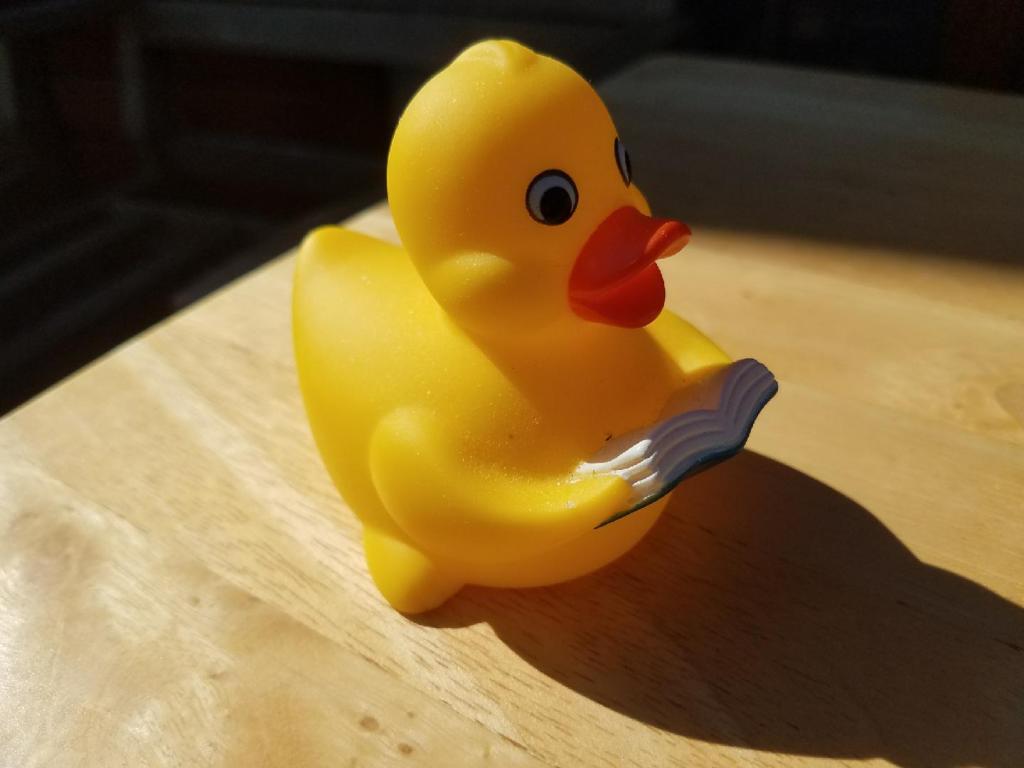
Why every writer needs a rubber duck

I spent this week at a writing retreat with a writer’s group I have belonged to for several years. This has become an annual event with of course the exception of 2020. Although the retreat is not far from home it is like stepping into a different world. A lane that resembles a farm track, takes us away from the industrial estates and traffic to a low, wide gate. We enter the numerical code and drive through. The gate closes behind us and with it the outside world. Our home for the next four days is a beautiful Georgian mansion set in 52 acres of private woodland and landscaped gardens, with two ponds and a large lake attracting wildlife. There is no need to leave our paradise as we have bought enough food and drink to feed twice as many people for two weeks. 

For me, a writing retreat is about having the mental space and time to focus on my writing in an environment that stimulates creativity and soothes the soul. This year I started each day with a pre-recorded yoga class and meditation. I had not done this at previous retreats and it made a significant difference. It gave me a sense of calm, clarity, and a deep appreciation for all that I was experiencing. My novel progressed well and I was able to reflect on my writing journey.

One of the greatest benefits of a retreat with writer friends is being able to share a writing problem – whether it is finding the right word, testing out novel titles or just talking through a dilemma. 

One afternoon, I was sitting in the sun chewing over a marketing problem. I had great plans but I wasn’t sure how I was going to schedule everything. As I scribbled different project plans in my notebook, a writer friend settled herself in the corner sofa opposite me to drink her coffee. ‘I was just trying to work out how I’m going to…’ I started to explain step by step my problem. Without her saying a word I had two aha moments. The solution seemed obvious now I had explained it. I finished by telling her exactly what I needed to do.

‘That,’ my friend explained, ‘is what’s called rubber duck debugging. It’s a technique used in programming. When you explain a problem to someone else the solution becomes apparent. Rather than take a colleague’s time a programmer talks to a rubber duck and it has the same effect.’ I loved this idea. Although talking to my bright and interested friend drinking coffee in the sunshine was far better than sitting at a desk with a rubber duck for company.

Curtesy of Anita Belli

It made me think. This is what I did in my working life. Talking through work problems at meetings with colleagues, giving presentations and lectures, it deepened my understanding of a topic and gave me insight. Creatives often spend a lot of time alone and so we need to find ways to create this practice. Journaling can work but sometimes we need to talk through the problem to get clarity. Fortunately, I have a few good female friends who will listen to me as we walk and talk without feeling the need to come up with answers and this is invaluable. And if not, I could run myself a hot bubble bath and chat to my duck.

I came away from the writing retreat feeling calm, in control, and inspired. By stepping into that other world, I gained a new perspective on my writing life. I had been full of angst worrying about the future and doubting myself. Something magical happened in that Georgian house because now I am content and confident. I am completely relaxed about my writing life and excited to try out some new ideas.

Retreats are not accessible to all creatives. Finance, location, and other factors can be a barrier. If you cannot get away alone or with other creatives then perhaps you could create a retreat environment at home. A different schedule and way of working where you commit to self-care for a few days. Turn off all distractions and use your creative powers to imagine yourself on a retreat. The tweet-chat that I host Friday Salon (#FriSalon) have suggested we have a virtual writing retreat. I am thinking about how we can do this effectively. If you have experienced a virtual retreat, then please let me know how it worked. 

Next week I am sleeping out as part of the GlassDoor London Sleep Out, raising awareness and funding for this charity which helps people find a path out of homelessness and provides support. It is on Friday 1st/2ndOctober. Starting to feel a bit anxious now as I haven’t travelled into London since the pandemic and sleeping on the street amongst strangers is most definitely out of my comfort zone. I will report back here next Monday! Until then …

How cyclical living can improve creativity

For everything there is a season, A time for every activity under heavenA time to be born and a time to die. A time to plant and a time to harvest. Ecclesiastes 3:1-8

Whatever our religion or beliefs, we all experience the changing of seasons. Here, in England, it is feeling very autumnal despite it being mid-August. The sun is lower in the sky, and I have spied a few bejewelled spiders webs early in the morning when the scent of dew on grass reminds me of camping or the first day back at school. I love September. Although it is decades since I lived by the rhythm of school terms, to me, September always feels like a new beginning. 

I host a weekly chat on Twitter #FriSalon. Last week the topic was the impact of summer on our writing. August, is traditionally the month of holidays, a time when business slows down. In the past, factories closed; school holidays were originally planned so that children could assist with bringing in the harvest. Although some of the writers in our chat were required to work harder in August due to work pressures (not necessarily writing), the majority saw it as a time to unwind, to relax with family and friends. We talked about the natural cycle for writers – how ideas could flow triggering great productivity, and the times between when ideas could not be forced. Recognising when we need to take a break from writing to refill our creative well and sometimes to just rest.

Everything in nature has a season, these invisible rhythms flow through every living thing. Often our moods match the time of year, a lethargy and wish to hibernate in the winter, a surge of energy in the spring, but we also experience our own cyclical changes. I have always been driven to achieve my goals and impatient with myself when I feel as though I am failing. Learning to be kind to myself is an ongoing challenge for me. 

JillWellington – Pixabay

In past blogs I have talked about consistency, showing up every day no matter what and I do believe that these daily habits help us to shape the life we want to live. However, we need to do this with self-awareness. Recognising when we need to be still and rest. When having fun and experiencing life is more important than writing about it. If we need to curl up with a book and hibernate, to honour that need. By recognising our cyclical nature and allowing those natural rhythms to flow we will achieve more. 

I have slowed down a little since losing my father earlier this year; this month we are having a memorial service and interment so we can say goodbye properly. It hasn’t stopped me from completing my third novel, Little Gold Lies, or starting a fourth but I feel quieter and less energised. Reflecting on how to live cyclically has helped me to accept this change of pace and to allow myself time to adjust. The past year has taken its toll on us all. There will be new growth and abundance but it is okay to be still and take stock.

I have achieved a great deal since the start of 2020 channelling my creative energy and determination into exciting new projects. Now, it is perhaps a time for me to enjoy the harvest. To consider where I am and where I want to be. To prepare the ground for new seeds of possibility. 

August may feel like a wash-out weather wise as we have had lots of rain in the UK, but there are still a few weeks left of the holiday month. I intend to have fun, maybe plan a trip into London to visit an exhibition or a museum, to work my way through the books on my Kindle and bookshelf, and maybe even watch a film or Netflix series during the day – that is something I would never normally do. When September comes – a new term, I will be refreshed and ready to take on new challenges with energy and enthusiasm. 

I hope that you are enjoying your summer and nurturing your creativity by allowing it to lay dormant if that is what it needs or indeed flourish. Go with the flow!  

How to coax your muse out of hiding

All writers have days, sometimes weeks when the words will not flow on the page. It is frustrating when you think you know what you want to say but it doesn’t come out right. I have had that experience in the past when describing myself and my writing for my website author page, and this week when making several false starts on my new novel. I have learnt that the reason I cannot find the right words is because I do not truly know what I want to say. I am not ready to start writing because my ideas are not fully formed.

Dig Deep

I have been working on my author page this week and after a year of grappling with my identity as an author, I am now able to write confidently about who I am and what I write. It sounds simple but any author who has tried to do this in the first few months of their career will, I suspect, identify with this. There is a bit of imposter syndrome. Fear of exposing who we really are – being authentic makes us vulnerable, as we get used to presenting to the world the image of ourselves that is most acceptable. Writing this blog and digging deep as I write my stories has helped me to see and value what makes me unique. That thing which once seemed so nebulous – my writing voice. If you are struggling to describe yourself as a writer – don’t read other author’s pages looking for inspiration – go within. Sit with yourself and take the time to understand who this amazing person is – because you are extraordinary. Only you can write what you write because it comes from your unique experience of the world. 

StefanKeller Pixabay

Be patient

Starting to write a new novel is exciting. It is also a little scary as I explained in last week’s blog. I have been thinking about this novel since I had the first inspiration in February 2019. I have pages of notes, loads of research and I know the beginning, middle, and end. What I don’t yet know are the characters or how to get into the story. I read a note by Rachel Joyce in the back of her novel, Miss Benson’s Beetle – a novel I greatly enjoyed and can recommend – she said that she walked around her story idea as though it were a house and couldn’t find her way in. For Rachel Joyce, it was seeing an old photograph of two women that spoke to her and enabled her to dive into writing that story because it was then that she discovered her protagonists. 

I have stopped trying to hunt down my ideas because the more I stalk them, the further into hiding they go. It is a waste of my time sitting at my computer attempting to write yet another chapter that will end up being deleted, or scribbling longhand in my notebook. My mind needs to be still and diverted for inspiration to come creeping out. I woke up this morning with a revelation. I was starting my novel in the wrong place and from the wrong point of view. It was as though my ideas had been given a good shake whilst I slept and now, they came tumbling in a different order giving me a new perspective. My first attempts did not work because the ideas were not fully formed. Understanding the heart of your story and the journey you want to take the reader on is crucial. The magic in writing is that the story unfolds as you go along but you need to be true to what you set out to achieve. 

MarDais Pixabay

Have faith

When I first started writing this blog, I was afraid that I would run out of ideas. Each week I fretted over what I would write and if I had not written and scheduled the blog by midweek I panicked. Now, I have a weekly ritual. Every Sunday I get up early for a run by the sea. I warm up with 10 minutes of yoga then head out. This morning, I was blessed as the tide was out exposing a long sandy beach. There was a mist on the horizon and the air smelt so good – of roses from the green slopes above mingled with the scent of the sea and a promise of rain. It is easy to empty the mind running in such a beautiful setting. I never set out to think of a topic for my blog but at the end of each run, I know what to write. It is a time of quiet reflection when I listen to my inner voice. On my return, I scribble a few notes to capture ideas for future blogs, before doing ten minutes of post-run yoga and my daily meditation. This is the only time in my life when I can honestly say that I completely let go of control and trust the process. When I was running today, I wondered what might happen if I applied the same faith to my daily life. 

The creative process is a miraculous thing. It comes from somewhere deep inside. We are conditioned to be busy and productive but that is not how creativity works. It takes its own time and requires us only to be still, to trust, listen, and to be patient. Because that is when the magic happens. 

How Creativity Can Change Your Life

I believe the pandemic has triggered a resurgence in creativity. When the constraints of our lives loosened and we no longer had to adhere to a busy schedule, we found space. Initially, a space where we faced fear, anxiety and confusion. Our worlds tilted and nothing made any sense. Livelihoods were threatened and we were filled with the necessity of finding a different way to be.

Creativity is not just about the arts, an ability to draw, paint, or write. It is about viewing the world from different perspectives, finding hidden connections and meaning, solving problems, and turning our ideas into reality. We are all creative. We are creation.

In these challenging times we need our creativity more than ever. The pandemic has forced us to find new ways to do things and, in some cases, to make a living. 

In the past year we have seen choirs and orchestras come together to perform using the internet, extraordinary fundraising activities such as Captain Tom’s sponsored walk, global meditation initiatives, and innovative approaches within communities, and families, to support one another and carry on. This is creativity at work.

Creativity connects us to one another in a meaningful way. It may be an idea that inspires others, or a collective energy as we come together with a common goal.

I have watched as people around me find time to pursue creative hobbies: writing, painting, craft work, sewing. When we become absorbed in a creative activity we relax and the constant chatter in our head is silenced. This stillness is like meditation. It is calming and improves our well-being. 

When it feels as though the world does not make any sense, we can connect on a deeper level through our art. In the past year I have engaged for the first time in social media. In the past I was reluctant to use Twitter or Facebook but I have been amazed by the kind, generous, and loving spirits I have encountered. A photograph of a sunset. An inspirational quote. Words of encouragement to a stranger. The message to a person who is afraid and suffering that they are not alone. A few words. An image. Sometimes, I imagine these beautiful souls like glittering diamonds connected in a magnificent web of light encircling our globe.

Pezibear Pixabay

On Sunday morning we changed to British Summer Time in the UK and our clocks went forward. It is interesting that this year my husband and I both woke up an hour earlier in the days before the clocks changed. I wonder whether we have become more in tune with nature in the stillness created by this quieter way of life? It is almost as if the global pandemic has given us a reset. 

It is a year since the first lockdown and we have all changed. It has taken me a while to adjust to a different rhythm. To stop railing against what I saw as restrictions and to welcome this time of solitude and reflection. To be still and listen to what is in our heart can be scary. It can expose difficult emotions, and memories. With self-love and compassion, we might be able to acknowledge these and find some peace. I remember a difficult time in my life some years ago. I had been looking forward to taking the whole of August off from work. I had such plans for relaxation and fun activities. It was one of the worst months of my life because when I stopped being busy thoughts and feelings surfaced that I had repressed for many months since the death of my mother. However, that month away from work was exactly what I needed to do the inner work and to put right the things in my life that needed to be addressed. 

Across the world we have experienced this time of change and reflection together. There have and will continue to be hardships. We have lost loved ones and a way of life that we treasured. But I believe we have found something else, our creativity, compassion, and resilience. If the world has had a reset, let’s start afresh and use what we have learned to create a better life.

The writer’s notebook.

I know from conversations on social media that most writers have many notebooks. We love choosing or receiving notebooks with pretty covers to fill with scribbled thoughts. I currently have nine notebooks that are still ‘open’. Which means there are still empty pages to fill, and ideas I want to pursue. I kept journals long before I started writing, and could not count how many I filled over the past decades. Fortunately, most of these have been disposed of, or I would have to buy a bigger house. Although I did tear out a few important pages to keep because they still have meaning today.

Each notebook has a different purpose, although ideas spill over from one to another in a jumble of ideas and impressions. Doris Lessing famously kept five notebooks, which she wrote about in the 1962 feminist classic, The Golden Notebook. Each notebook was of a different colour: autobiographical, confessional, a writer’s observations, political musings, and a golden notebook that pulled all of the threads together. I read this book a long time ago and although I struggled with some sections it left an impression on me. It is perhaps time that I read it again now I am older and have a different perspective on life.

Courtesy of Gimp Workshop Pixabay

Journaling 

The pages I have kept are those which serve to remind me that all will be well if I go inwards to listen to what is in my heart; to find guidance from God, the universe, guardian angels, inner wisdom, whatever you choose to name that power. The journals that I filled in my thirties were full of angst about my career development and frustration that the path I had envisioned seemed closed to me. Years later when I read those journal pages I was filled with compassion for the younger me. Everything turned out perfectly, better than I could have imagined. I just needed to be patient and open to new opportunities. Using a different coloured pen, I wrote responses to my younger self between the lines and in the margins. I reassured myself that all would be well. These are the journal notes I have kept, because now if I pour my angst out on the page I imagine an older version of me responding in the margins – all will be well. 

‘In the diary you find proof that in situations which today would seem unbearable, you lived, looked around and wrote down observations, that this right hand moved then as it does today, when we may be wiser because we are able to look back upon our former condition, and for that very reason have got to admit the courage of our earlier striving in which we persisted even in sheer ignorance Franz Kafka.’ The Diaries 1910-1923
 
‘I am anxious, and it soothes me to express myself here. It is like whispering to one’s self and listening at the same time.’ Bram Stoker Dracula

courtesy of S.Hermann F. Ritcher Pixabay

Morning pages

Writer’s keep notebooks to jot down impressions, observations, and ideas. Inspirations for stories, snatches of dialogue, and interesting names. I always take a notebook on holiday with me to record the scents, sounds, and sights that make a place unique. I have one notebook especially for holidays so that I can dip into this if I am describing a location.

Julia Cameron introduced a writing exercise Morning pages in her book The Artist’s Way. She encourages writers to warm up each morning by writing freely for a few minutes. It is a way to relax into using the right side of the brain and to stimulate creativity. My morning pages are scattered throughout several notebooks. As these scribblings are intended to be disposable, they randomly fill gaps – but amongst those scribbles, there are a few ideas that one day maybe the seeds of a story.

‘Your subconscious mind is trying to help you all the time. That’s why I keep a journal – not for chatter but for mostly the images that flow into the mind or little ideas. I keep a running journal, and I have all of my life, so it’s like your gold mine when you start writing.’ Jim Harrison
 
I don’t journal to ‘be productive.’ I don’t do it to find great ideas or to put down prose I can later publish. The pages aren’t intended for anyone but me. It’s the most cost-effective therapy I’ve ever found.’ Tim Ferriss
 

Planning novels

Then, there are the special notebooks. The ones that I designate for each novel. All of my ideas, planning, character development, photographs, news clippings, notes from research visits, etc. are recorded here.

When I designate a notebook for a novel I know that I have committed to writing that story. I have a notebook for an unnamed novel that I have yet to write. Whilst I am writing, Misdirection, and preparing Just Bea for publication, I am also jotting notes and references in a notebook for this unnamed novel.

All of the ideas that seeded my novels came from scribbles in notebooks. Passing thoughts that I captured and pressed between the pages for safekeeping. Although I might flick through my notebooks looking for inspiration, there is no need. The unconscious mind is busy sifting and selecting the thoughts I have recorded. Overtime a story emerges, sometimes fully formed and it nags to be told. 

courtesy of Raphaël Jeanneret Pixabay

Acquiring a journaling practice

You don’t have to be a writer to keep a journal. It is a form of meditation and reflection. A way to make sense of the world, and to self-care. Don’t think about what to write, just write. It is when you are relaxed with no expectation that thoughts flow. 

The notebooks and diaries of many famous writers have been published: William Somerset Maughan, Coleridge, Virginia Woolf, Mark Twain, Sylvia Plath, and Thomas Mann, to name but a few. Anne Frank’s diary deserves a line of its own.

How do you use your notebooks?

Unleashing creativity and purpose

September a time for new beginnings

September has always been my favourite month of the year. A new school-term. A new rough book and a sharp pencil. A new teacher, excited to introduce the term’s work, and to learn our names. It’s a time of new possibilities. The harvest has been gathered in and the fields lie fallow, waiting for new crops to be sown.

It is the month I got married, and the month our daughter was born. When the leaves start to fall and my pockets fill with shiny conkers and acorns snug within their cups, my heart soars. I went for a run this morning, delighting in the crunch of leaves beneath my feet and the golden glow of sun, low in the sky now that summer has been spent. I got to thinking. This time in my life, it is like the fall. My achievements: building a successful business, raising a family, caring for ageing parents, are my harvest. I have toiled hard and loved every moment, but it is now done. Like the bronze and gold leaves at my feet, I have shed these responsibilities, and I am at a new stage in my life. A time to create something new.

Creativity increases during and post menopause

There is scientific evidence that women become more creative during and after menopause as a result of hormonal change (Dr. Christaine Northrup https://www.drnorthrup.com). I believe it is more than hormonal change. Men and women reach a time in their life when they experience a freedom that they haven’t known before. The harvest has been gathered and we reflect on the fallow field before us. We become introspective, questioning our true purpose in life. No longer required to serve others, we can dance to our own tune. In this time of reflection, we discover our intuition and insightfulness. It is no wonder we experience a surge of creativity. Alan Titchmarsh, once said on a Gardening programme, that we become invigorated in the spring because we can smell the plant sap of new growth. Maybe it is sensing our unfulfilled potential that awakens our longing to create when we begin our autumn years.

Don’t let a believe that it is too late to fulfil your dreams hold you back. I was really inspired by Penelope Fitzgerald’s story, (see Hermione Lee’s biography). Fitzgerald started publishing her books at the age of sixty. At the age of eighty, she became famous after winning the Booker Prize in 1978 for her novel Offshore, and then international fame when The Blue Flower won a major award in America. Her novels, like mine, tend to be about people living on the edges of society, combining pathos with humour. Maybe that’s why I was drawn to her work. She was a remarkable woman who led a full and fascinating life, experiencing hardship herself for many years.

Your creative yearnings may not be as a writer. We are all creative, and fulfilling this need is as important as our spiritual, physical, psychological, and emotional needs. Your creativity might be expressed in the interior design of your home, a meal prepared for friends, quilting, or gardening. The list is endless. What is important is that you make time to express your creativity and enjoy it.

A new term

Photo by Pixabay on Pexels.com

I remember travelling home from work on the train one evening on the first day of term. The carriage was static with excitement and anticipation as students of all ages chatted about the courses they were studying. A couple of women were getting to know one another, as they spoke about the healthcare module they had just begun. A group of teenagers compared subject choices, eager to share how they saw their future unfolding with university options and careers. I breathed in the energy and felt high! 

Autumn is a time of change. Of new beginnings. Maybe you are thinking about retirement or your children have left home for university. Approach the coming months as though it is a new term. There is a fallow field before you. Now is the time to unleash your creativity. It is exciting and it may be a little scary, but beginnings always are. 

I will be spending the months leading up to Christmas writing my third novel, Misdirection, and learning about marketing as I prepare to launch my second novel Just Bea on 1st February. I would love to hear about your plans whether it is a craft project, your garden, or your novel/poetry. Let’s be like the teenagers buzzing with news about their plans on the first day back at school!

No more writer’s block

Writing, painting and, playing music are like meditation. You know that feeling when you’re in the zone? For me, it feels like slipping into a quiet place in my head, where ideas flow without me having to think too much about it. 

Using the right side of the brain

I came across Betty Edwards, Drawing on the right side of your brain, when I was practicing life drawing, several years ago. She explains that the left side of our brain is concerned with logical thought and the right with creativity. Betty Edwards, can explain this much better than me, see her website and blogs https://www.drawright.com

When we are writing or drawing and allow the right side of our brain to lead, we allow our creativity to flow unchecked. The left side of our brain wants to analyse what we are doing and judge how good it is. When I was worried about whether my debut novel would find a market, my mind went blank. I didn’t think that I had another novel idea in me. Everything that came into my head, I dismissed. The left side of my brain squashed any glimmer of creative thought.

Writers’ block

 Writers and artists need to have a business head, selling our work is a business. But we have to separate this from the creative process. When a person complains of writers’ block, I believe it is because they cannot quieten the left side of the brain and tune in to their creativity using the right side. 

Meditation Writing Exercises

This is where meditation helps. The deep relaxation of meditation stills your mind. That feeling of being aware but also in a dreamlike state is similar to being in the zone. If you can prepare to write by first meditating, you may find that ideas come more easily and you switch off the critical part of your brain that tries to censor what you write. 

Julia Cameron introduced Morning pages in her book The Artists Way (1992). Check out Julia’s blogs on creativity https://juliacameronlive.com/basic-tools/morning-pages/

Morning Pages are a daily practice of writing first thing in the morning, allowing a stream of consciousness to flow, to stimulate creativity. This exercise is making the most of your body’s relaxed state on waking, to tune in to the right side of the brain. 

Try writing something immediately after your meditation practice. Don’t worry about grammar, spelling, or sentence structure. Just write. I use notebooks for these and never travel without one. When I read them back, I’m sometimes surprised at the beauty of the writing. If I had set out to write in that way, I wouldn’t have been able to. It comes from somewhere deep inside and I need to be in that relaxed meditative state. 

You might also try a guided meditation on creativity. There are a few but I recommend Mind Valley’s one, see my blog Meditation Challenge Part Two.

The Artist Within

I started this blog by saying, writing and drawing are like meditating. To improve any of these skills, you need to practice, ideally a daily routine. When you first start to meditate you will find that your mind wanders and you have to gently bring it back to the present. It’s the same when you’re writing. You want to focus inward but the left side of your brain keeps trying to tug you back, distracting you with daily trivia or criticising your inner voice. That’s okay, just as in meditation, you patiently refocus until you find yourself in the zone. 

Namaste

At the end of a yoga class we say to one another ‘Namaste’. This, as you no doubt know, means, ‘The divine in me bows to the divine in you.’ 

I think that as writers and artists we are connecting the divine in us with the divine in others. Creating from the heart, we are offering up something of ourselves. It will be received and interpreted by others, as it touches something in them, this could be excitement, empathy, joy or inspiration. A good book makes you forget the outside world as you absorb yourself in an imaginary world. Art and music can touch us in a profound way.

Keep yourself in brackets

When I was learning how to facilitate group work as a health and social care professional, a wise mentor said to me, ‘You need to keep yourself in brackets.’ I think that we have that same responsibility as writers. If the divine in me is to connect with readers on an emotional level, they need to believe in the world I have created and not be jarred into the present by an awareness of the writer. That can be a narrative tone, which is like the writer looking over your shoulder explaining why they wrote a particular line or too much disclosure on social media. There is a fine balance between getting to know a writer and maintaining a sense of mystery and awe. I hate it when I love an actor in a particular role and then I find out that they are not a nice person. 

And so, I will refrain from telling you about the contents of my laundry basket and instead wish you Namaste, until next week when the topic will be how reading and writing can help us to develop greater empathy. 

Meditation Challenge part two

Learning to be patient

In The Meditation Challenge part one, I told you how mindfulness meditation helped to still my mind so that I could stop fretting about the approval of a literary agent and instead focus on writing my best work. If you are having a go at meditation to help you manage similar anxieties, I would love to hear from you.

I knew, in my heart of hearts, that if this draft of my novel didn’t meet with my agent’s expectation then we might well be saying goodbye. I should add here, that whilst I had been working with an agent for over a year, I hadn’t actually signed a contract, or met her, or even spoken on the phone, although her in-house editor did have a very helpful phone conversation with me early on in the process. This agent is one of the best, many of the authors she represents are international bestsellers. Her agency was growing and changing. It’s no wonder that she could spare me little time and was slow in replying to emails. 

Writer friends cautioned me but I was willing to accept these terms as I was gaining a lot from the editorial comments on each draft of my manuscript. In my head, I likened it to dating. The same feelings of excitement and apprehension as I waited impatiently for her reply.

I needed meditation more than ever. By now, I had progressed to longer meditations. I particularly liked:

If that one thing would happen – my life would be different.

Tara Brach www.tarabrach.com generously shares hour-long seminars on meditation practice. I would listen to these whilst ironing or making the evening meal, headphones on. In one of these seminars she said something that struck a chord with me. I’m sorry but I can’t remember which one it was. Anyway, it was something like this: 

We believe that if this one thing would happen, maybe meet the right man/woman, get a promotion, or in my case get published, that everything in our world will be better. We give this monumental importance. Just as we do in fearing something really bad. But, when this ‘thing’ actually happens it’s just a blip up or down in our state of being. Think about it – that job you finally got, getting pregnant, meeting the man or woman of your dreams. Or, the bad stuff, being made redundant, having your manuscript rejected. There’s a short period of euphoria or depression and then life resumes. It doesn’t change everything. 

I have just discovered Daniel Nussbaummüller’s  blog  https://embraze.org/how-our-thoughts-make-us-suffer/on Thoughts Make You Suffer, says a similar thing. 

So, when my agent responded in May to say that she loved the changes that I had made to my manuscript and with just a couple of tweaks, she would be excited to send it out to publishing editors, I was of course thrilled. My journal reads, ‘It has finally happened. I have reached a milestone – jumped a hurdle. My novel is to be sent out to publishers and an amazing agent wants to represent me.’ I checked that she really was my agent, just in case I had been deceiving myself, and she confirmed that she was. I told my writer friends on Facebook, did the edits and sent it back. My agent said that she would send me her marketing strategy and so I waited. 

I don’t know whether it was Tara Brach’s influence or my meditation practice but I was very calm. I think as writer’s we take tiny steps. I imagine us all hiking up a mountain, the path curving around and upward, like a spiral. Each step is small, it’s only when you look down that you see just how far you have come. 

Maybe, it’s watching or reading about drama’s, great personal success stories, that we crave the elation of those dizzying heights. The reality is, change is more often gradual. But that doesn’t make for a sensational story.

Meditation to help generate new ideas

Whilst sending off each rewrite of my novel and waiting for my agent’s response, I had gone back to two of my unpublished novels trying to rework them in readiness for my agent’s approval. That was before I started my meditation challenge and it hadn’t gone well as I was just too critical of my work. I was afraid that I didn’t have anything else to offer. Now, with the benefit of meditation, my mind was more open to new ideas.

 I found an excellent meditation for creativity through Mind Valley www.mindvalley.com. It is free to access on YouTube. https://www.youtube.com/watch?v=NSqEYFsF3w8

 I did this creativity meditation several times. On one occasion, I did it before going to bed. At around four in the morning, I woke up with so many ideas, I jumped out of bed and wrote them down. My second novel came to me so fast I couldn’t stop writing. I forgot to worry about not receiving a publishing plan from my agent. Until July when I prompted her.

 In next week’s blog I will tell you how meditation helped me to manage my expectations and anxiety when my novel was out on submission ie. being considered by publishers.

Part one

Part three

Part four