Friendships and community

Novels about community

A theme in The Borrowed Boy, my debut novel, is our need to belong. From the day we start school and find ourselves alone on the playground, to later life when we may find ourselves living alone in a house, no longer known to our neighbours. We all have an innate need to be seen, valued, and respected.

In recent years there have been a number of bestselling novels with the theme of community and friendships combatting loneliness: Mr. Doubler Begins Again, Seni Glaister, Eleanor Oliphant is Completely Fine, Gail Honeyman, The Authenticity Project, Clare Pooley and Saving Missy, Beth Morrey, to name just a few. Why is there an appetite for these heart-warming stories?

Our need to belong

I believe it is because we have all at some time experienced a need to belong, and can identify with the feelings of isolation and loneliness experienced by the protagonists in these stories. Life changes such as:

  • Moving into a new neighbourhood.
  • Retiring from work
  • Having a baby
  • Changing schools
  • Losing a loved one

Can all leave us feeling like that lost child on the playground, watching everyone else having fun as they run past in a game of tag, not seeming to see us. Yes, I was that child for a year or so – unable to join in because I had always played games with my little sister, who was too young for school, and I had not learnt how to make friends.

I wonder whether society is becoming more fragmented, as we lose the sense of community. People who go out to work, seem to be working longer hours. Out of town superstores have replaced a reliance on small local shops. Children and grandchildren often live overseas or on the other side of the country. Communities are transient, particularly in London, where few of the residents have lived in the same street for more than five years. There is a hankering after a by-gone age when people knew all of their neighbours and looked out for one another.

How the pandemic brought communities closer together

The pandemic will have cast a light on each of our neighbourhoods. In the UK we were encouraged to stand outside our home, every Thursday evening to clap in appreciation of our NHS. On those evenings I noticed a few of our neighbours for the first time. We started to talk to each other, checking that all is well. We also went back to buying locally, supporting local businesses, and frequenting the neighbourhood convenience store. As life changed, some of us were able to take a step back from our busy lives and rediscover the importance of family, and community.

Communities come together when there is a disaster, whether it is a flood, forest fires or as in this case a pandemic. We seem to have the instinct to come together and support one another. Academics have questioned whether this can be engineered and many attempts have been made by pioneers such as the ABCD (Asset-Based Community Development) movement which started in the USA in the 1960s in an attempt to rebuild troubled communities, and closer to home the Troubled Families Programme, which aimed to build a network of support around families struggling with multiple problems. These approaches have been successful, but they tend to create a dependence upon the paid staff. They hit the target but miss the point. 

Combatting loneliness and isolation

 A person who is lonely does not get the same satisfaction from a companion who has been paid to spend time with them, or a volunteer who is providing companionship under the banner of a charity. We all want real friendships where there is a reciprocal benefit. Having a common purpose brings together people from different backgrounds with different skills and life experiences. A bit like a team-building exercise, everyone does what they can and we are sometimes surprised to find out about peoples’ hidden talents. 

In 2013 Marc Mordey and I embarked on a project. We wanted to find out if we could bring people together in a neighbourhood and enable them to be self-sustaining through real friendships and shared interests. Our premise was: everyone has something of value to contribute, the gifts of experience, knowledge, or practical skills. Our aim was to bring together a neighbourhood and enable them to share what they had to make it a better place to live. 

We worked with neighbours in two London areas, Dagenham and Balham. We learned a lot. The pilot projects have been evaluated by SITRA (2014) and written up in several publications.

The community in The Borrowed Boy

But this isn’t an academic paper, I wanted to shine a light on the theme of community in The Borrowed Boy. There are two hidden communities in the story. Hidden, because sometimes we only see what we expect to see. I’ll let you read the book and come to your own conclusions.

Although Jaywick Sands is a real place on the Essex coast, the places and people in the story are entirely fictional. For fun, I have applied some of our learning on communities to this fictitious community.

Every neighbourhood has a unique character.

  • The residents of Jaywick were suspicious of anyone from outside their community. 
  • They were united in a common cause, to persuade the Council to provide better living conditions. 
  • Most of the residents were living in poverty but they shared what they had. 
  • Although it had seen better days, residents were proud of their seaside village with its sandy beaches.

There are key people and places within a community that hold it together.

  • Josie and The Seashell café provided a hub for this community. Josie knew all that was going on. She put people in contact with each other and knew when a person needed a bit of extra support. 

Clubs and associations provide a community’s network

  • When Josie needed to activate the community to see off an unwelcome visitor, she commandeered the assistance of: the dog walkers, Harley Hell Raisers (the local biking club), the kids who gathered in the square with their bicycles, the Queens Head publican and a few of their patrons.
  • A councillor tried to influence this community by inviting them to a social event at the Community Centre. The residents turned up for the fish and chips and booze, some enjoyed a dance, but without Josie on board, the Councillor was wasting his breath. 

How would you describe the unique characteristics of your own neighbourhood, or the fictitious one in your novel? 

Who are the people who know what is going on and make things happen?

Which clubs and associations did you miss most in lockdown? 

How do these serve to keep you connected and part of your local community?

I hope you will join me on some of the blog stops for the blog tour of The Borrowed Boy which starts on 1stAugust. See My books for the full programme. 
Holiday nostalgia

The Borrowed Boy is set in Jaywick Sands, a seaside village a few miles from where I live on the Essex coast (England). I was inspired to write this story after riding my bicycle along a cycle path from Clacton pier to Jaywick, a journey that my protagonist Angie Winkle makes on several occasions. The postcard bottom left of the book cover is of Jaywick Sands.

Jaywick has been much aligned by the media. In October 2018 in the USA a Republican advert for Nick Stella used images of Jaywick Sands with the headline, What could happen if you don’t vote for Trump.’ There was of course outrage in the British press at this defamation of Jaywick using old images that did not reflect improvements by the local council. But the British media have also presented Jaywick negatively. A couple of years ago it was the focus of a TV series, Benefits Britain, which portrayed a small proportion of the village’s residents. 

There is no doubt about it, Jaywick is run down. It has been named the most deprived neighbourhood in England on the UK Government index, three times since 2010. However, people who have been rehoused from Jaywick into what are considered to be more affluent villages have told me that they miss the community spirit of Jaywick. ‘People look out for each other there,’ I have been told on more than one occasion. 

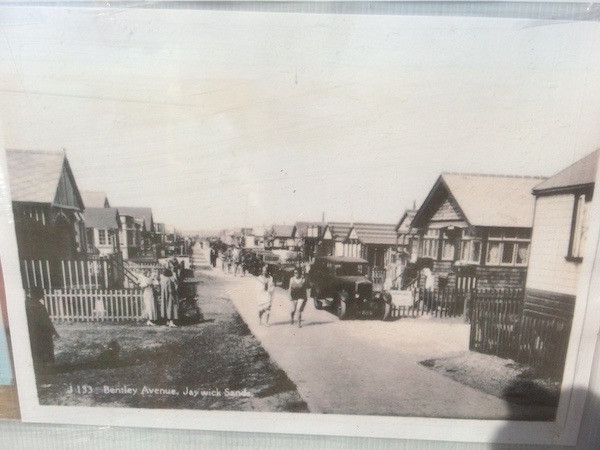
A London cabby spent an entire journey reminiscing about holidays spent at Jaywick Sands when he was a ‘nipper’. The internet is full of shared recollections of Jaywick in its heydays – the donkey rides on the beach, the little chalets with the Elsan toilets. My elderly neighbour grew up in Jaywick and remembers taking mugs of tea from his house to day-trippers on the beach. I think that Jaywick Sands is a very special place. In my author’s note at the back of the book, I have said a little about its history, but I wanted to share it with you here too. 

The Plotlands development craze

In 1928 Jaywick was developed as part of the Plotlands craze which was popular in South East England. Cheap agricultural land was sold off to Londoners so that they could build a holiday home. There were no building regulations and councils were not required to provide sanitation, electricity, or drainage. 

Land in Jaywick was bought up by employees of Ford’s, as it was relatively close to the Dagenham based factory. Chalets were typically constructed from Ford’s packing cases and the streets were named after cars. 

During the second world war, London’s East-enders moved out of their bombed homes to live permanently in Jaywick. Whereas other plotland sites in England were developed into new towns, Jaywick residents refused to budge. 

Over the year’s residents petitioned the council for funding towards sanitation and electricity and this common purpose created a strong sense of community.

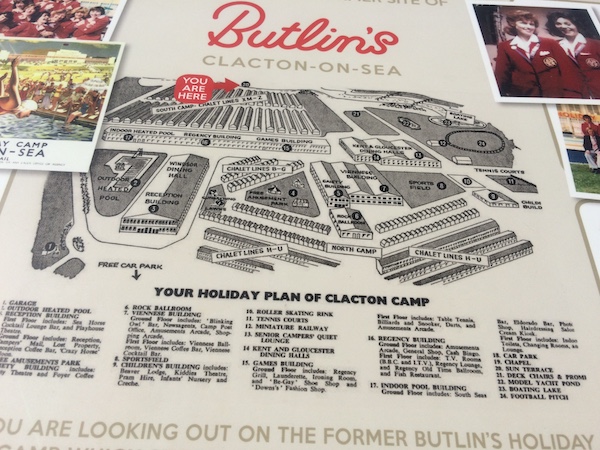
A copy of the campers map of Butlins and those famous redcoats who entertained us.

The closure of Butlins Holiday Camp in 1983 led to a further decline in the holiday village, although many Londoners today still treasure childhood memories of holidays spent on Jaywick’s sandy beach. 

Holiday experiences have changed so much since the 1960s. I never had a holiday abroad with my parents, I was one of four children and airfares were unaffordable. We went to holiday camps, like Butlins although the Pontins camp in Camber Sands was our favourite. 

The first time I went abroad was in 1979 when I went with a friend to Los Angeles on the Laker Sky Train. Freddie Laker brought down the cost of air travel and opened up many more opportunities for travel.  There was a time when cruises were a luxury that only an elite group could afford, but they have become much more accessible in the past few decades. Holiday experiences are about to change again, as the Pandemic of 2020 leaves its legacy on the travel industry. Maybe English seaside resorts will have a renaissance as the British rediscover holidays closer to home.

I hope that you enjoy visiting my fictitious version of Jaywick Sands in The Borrowed Boy and maybe discuss some of the themes in your reading group. 

You are not what you think

Cognitive dissonance

When I was a young occupational therapy student studying psychology, I was delighted by the word cognitive dissonance and it’s meaning. In simple terms, it’s when you are not sure that you are doing the right thing and so you balance reasoning in favour of the action you have taken. Like convincing yourself that the dress you bought was a good buy because although it doesn’t fit right now, it will when you lose that additional weight, and it was half price in the sale. It’s human nature that we always want to be right. In our quest to be right, our brains work overtime coming up with all the reasons that we are doing the right thing, even when our gut says we aren’t. 

Head or heart

In my blog Meditation challenge part two,  I was working with a leading literary agent to get my novel ready for submission to publishers. There are other times in my life where I have been led by my thoughts and not my heart, but I am going to use this example as I have learned something from the experience, that I would like to share.

I can put my finger on the date when I should have paused and taken stock. It was my birthday and I was out having lunch with a girlfriend when the email I had been waiting for showed up on my phone. Two weeks prior to this, I had submitted my edited manuscript to my agent. I was excited, as I believed I had responded to all of the points raised, and I was really pleased with what I had accomplished. This email was going to be BIG. She would love it! What if she didn’t? My hands trembled as I opened the message. It was a holding email; my agent was busy and would get back to me in a month. In fact, it was four months before I got a response. 

Thoughts are just thoughts

Our thoughts can drive us crazy, as we use them to try and make sense of our world – confirming our worst fears or imagining the reality we want to believe. Thoughts are not the reality, they are just thoughts. My thoughts at that time were: this is my only opportunity. Everything hangs on this agent’s response. When I didn’t hear back, I assumed the worst. I judged myself and started to lose confidence in my writing ability. My thoughts imprisoned me in a false reality.

Psychology tells us that our thoughts are not always rational. I got stuck in a loop where my thoughts resulted in a fear of failure. My emotional response to  perceived reality triggered further irrational thoughts. If only I could have broken that cycle by realising that they were just my thoughts. 

We always have choices

A good friend suggested to me that by not meeting with me or getting me to sign a contract, my agent was avoiding any attachment so that she could more easily drop me if we didn’t get a publishing contract. I didn’t disagree, all that my friend said was true. I was acting with my eyes open. However, this is where cognitive dissonance came in as I convinced myself that I didn’t have a choice. I reasoned that it didn’t matter because my agent was going to bring my manuscript to the attention of top publishers. She had an amazing reputation and I was lucky to have her representing me. I had nothing to lose. Besides, what if nobody else wants to represent me? a little voice in my head whispered. I didn’t think I had much choice. 

Feeling stuck

So often, we get stuck in a situation that is not serving us well, but we convince ourselves that there is no other way.

When we feel stuck it is often because we are believing something that is not true. There is always another way. Sometimes it feels as though there isn’t, but we just have to use our imagination – and that should be easy to us. We are creative people. 

Instead of trying to justify our actions or inaction by building a wall of perceived truth, we need to listen to our hearts. My heart was telling me that I wasn’t happy. If I had honoured myself with kindness, and acknowledged that although they felt real, my thoughts were just thoughts not reality, I might have broken free sooner. 

Sometimes we knock ourselves out by repeatedly hitting against a wall when all we have to do is walk around it. There is always another way.

Going forward

Looking back, I can understand now that my agent’s success at that time led to changes in her working life that she had not anticipated. When we parted company, she explained that her world had changed significantly since we started working together. I realise now that her lack of communication was no reflection on my writing ability, and wasn’t personal. I had responsibility for myself. There were other options. The editor who was working with me at that time also worked freelance. Since becoming an Indie author, this editor has worked with me on my next novel, and I hope that we will continue to work together.

It was fourteen months after receiving a holding email that signalled a change in my working relationship with my agent that I suggested it might be better for us to part company. I have had no regrets since, but I could have saved myself the misery and self-doubt of my negative thoughts.

Of course, I can still list all of the positives that justify why I stayed with that agent for a year longer than I perhaps should have done. Cognitive dissonance is a powerful thing. But, I have learned from this experience.

Lessons learned:

  • When something doesn’t feel right, listen to your heart (gut/intuition)
  • List the thoughts that are limiting you and then let them go.
  • When negative thoughts stick, be kind to yourself and allow time to shift your thinking.
  • Honour yourself with courage and respect, you are responsible for your destiny – nobody else has this power. 
  • When we still our thoughts and listen to our heart, a greater power reveals itself. 

Abundance – or how to get more followers

To receive without asking

It has become a joke between my daughter and me that, Sherman, my husband, always gets preferential treatment at holiday buffets. For example, several years ago, Sherman and I were on a cruise of the Nile. I was standing in a long line of people waiting for the chef to prepare an omelette. Sherman is not even in the queue, he is helping himself to a bread roll close by the omelette station. The chef calls him over and, with a grin and a wink, slides a fluffy omelette onto his plate. Why? Why does Sherman get his needs met without having to ask? I know it doesn’t seem fair.

We have been married for thirty-five years and I have learnt that shop assistants, strangers in cafés, and people we occasionally pass on the street, all want to talk to Sherman. Faces light up when he approaches. We visited a pub on one occasion whilst on holiday in Whitby, Yorkshire. Seven years later we returned to the same pub and the publican greeted Sherman recalling his last visit. I know that Sherman would have bought him a pint when they first met and would probably have made him laugh. But beneath his banter is a man who genuinely cares. He notices people and makes them feel special and included. He doesn’t do it for any kind of return. He loves people and has a generous nature.

My daughter told me that she tried the ‘Sherman technique’ whilst on holiday hoping that she would get preferential treatment at the buffet, and was disappointed to find that it didn’t work. And there is the trick – the lesson to be learned.

If you do something hoping to be rewarded in kind, you will be disappointed. Life doesn’t work like that. When I first started this blog, I checked the statistics a few times each week driving myself crazy with negative thoughts. Why would anyone follow my blog when there were more experienced people out there writing much more interesting stuff than me? Was I wasting my time? 

Checking stats

Then I had a revelation, and I have Lauryn Trimmer prostorybuilders.wordpress.com to thank for that. In a blog, Lauryn said quite simply, Don’t look at the view count on stats. Just don’t do it. That was all it needed. I went for a run and thought, why am I worrying about the stats? I am doing something that I love. The blog, sharing thoughts and ideas with like-minded people on social media, reading and reviewing other authors’ work, being part of a readers’ and writers’ community – I love these experiences and opportunities. By the end of that run, my mind set had changed. Now, I commit to all of these things for the joy that they bring – not for any expected return.

The law of abundance

Meditation teaches us that gratitude, love, and joy bring abundance into our lives. That people are attracted to positive energy. Abundance does not work like a weighing scale with each good deed or good thought rewarded in kind. By being happy with where you are and who you are, you radiate positivity. 

If you have been following my blogs, you will know that I started this journey as an Indie author/creative entrepreneur with mixed feelings: excited by the possibilities, but daunted by the challenge that lay ahead. It is still early days, but as I relax and enjoy connecting with other creatives without expectation, just a willingness to support others on a similar journey, people and opportunities have come into my life that I could not have anticipated. 

Networking

Social media can be a valuable tool for networking and may lead to more meaningful connections with others. It can also be soul destroying if you value your worth by how many followers or ‘likes’ that you have. Take pleasure in the process. Be kind. Be authentic. Don’t expect any return– but don’t be surprised when you are called to the front of the line to receive an omelette before having to ask.

I am ending this week’s blog with a favourite poem of mine. Many years ago, this was pinned above my desk as the words really resonate with me. It is by Robert Muller, former Assistant Secretary-General of the United Nations.

Decide to Network

Decide to network
Use every letter you write
Every conversation you have
Every meeting you attend
To express your fundamental beliefs and dreams
Affirm to others the vision of the world you want
Network through thought
Network through action
Network through love
Network through the spirit
You are the center of the world
You are a free, immensely powerful source
of life and goodness
Affirm it
Spread it
Radiate it
Think day and night about it
And you will see a miracle happen:
the greatness of your own life.
In a world of big powers, media, and monopolies
But of six billion individuals
Networking is the new freedom
the new democracy
a new form of happiness.

Robert Muller

Welcoming Change

Beginnings are scary.

I am writing this blog on the first day of the summer solstice, here in the Northern hemisphere. It seems fitting, as today I am writing about change. 

Steven Rogers said, ‘Beginnings are usually scary, endings are usually sad, but it’s what’s in the middle that counts.’ I am embarking on a change in my career and it is scary. I have been here before, when I moved from the clear career path as an executive manager in the NHS to a very different role working for the Audit Commission, a national regulator of local authority and health care services. Then, as now, I moved from the safety of a role where I was respected and knew what I was doing, to one where I felt like the new girl – clueless and deskilled.

In recent years, I have been letting my profile as a consultant in health and social care decline, so that I can commit more time to writing. Just thinking about this change gives me palpitations. It’s a mixture of fear and excitement. I worked hard to establish my management consultancy and it has been successful, but since my mother died a few years ago, I have been pursuing my passion for writing. Maybe her passing made me realise that I had to make the most of every day.

Finding the courage to take a new direction

It is easy to stay in a place where we feel comfortable, instead of taking a risk to follow our dreams. I am not suggesting writers should give up paid work to write full-time when they have no guaranteed income. I am in a fortunate position of being semi-retired and so I can afford to bring in less money and focus more on writing. But, when I was a hospital manager and stepped off the career ladder to take a route that was unfamiliar I had to be brave. It was the right decision for me and led to greater things than I could ever have imagined, but it took a leap of faith. 

Your heart tells you when it is time to make changes in your life, although it may take some time before you get the courage to listen to that inner voice and act. Letting go is the hardest part of that journey. If you are at the top of a mountain, feeling successful and valued, albeit unchallenged, stepping into the unknown is scary. If you have established a home routine that works and is comfortable, but no longer meets your needs, then disruption is scary.

The space between ending and beginning

Then, as now, emails relating to my day job went from a torrent of daily communications to a trickle and then nothing. Did that mean I was no longer important? I wasn’t needed? In the NHS Trust, there had been a reorganisation, and I had talked myself out of a job as I searched for a role that would enable me to improve services. All was quiet and I was afraid that I had wrecked my career.

 In that quiet time, I meditated and reflected. A mentor suggested the role I was in no longer fitted me. She suggested I spend time working out ‘my shape’ and then find a job to fit – keeping an open mind. If it hadn’t been for that space between the ending and beginning I would never have found my path. 

I am back in that place again today. I have intentionally let my consultancy business decline, turning down work, and moving my focus from networking with health and social care colleagues to networking with the writing community. I am in the space between, feeling my way, uncertain what the future may hold. Everything is unfamiliar and I am pushing myself every day to learn new skills: setting up this blog, using social media to network, publishing my debut. I am no longer the expert, the person to go to, a person well connected within a community. Maybe one day I will be, but now I am at the bottom of a mountain, with a steep climb ahead.

Fulfilling our potential

Everything has a season. A beginning, a middle and an end. Like our breath. It is the pause between breaths, the space between thoughts where the divine happens. We have to be still, to hear what is in our heart, and be open to new possibilities. We don’t know what the future will look like, we just have to have enough faith to let go of the old. Then wait. Beneath the ground nature takes its course and seeds germinate. Looking at bare soil is very, very scary. 

If we cling to what we know and never have the courage to learn something new, then we fail to fulfil our potential. Isn’t that what we are all here to do? To be the best version of ourselves that we can? This weekend it is International yoga day and the summer solstice here in the UK. As we go into the first day of summer, I hope that your harvest is plentiful and your dreams fulfilled. Namaste. 

Balancing Time

Balancing commitments

‘I would find it hard shutting the door on my husband and children, saying I needed time to write,’ a woman once said to me, when I was giving a library reading. She longed to be a writer but didn’t honour herself by protecting her writing time.

This is so often a problem for woman, and I suspect men, as many are homemakers and care givers. When we take time for ourselves, we may feel guilty and sometimes use this as an excuse not to follow our dreams. 

When our daughter was born thirty years ago, my husband gave up work to be a full-time dad. He never went back to work, through choice, and I have been the sole wage earner for our little family. It worked for us and I have no regrets. However, when I was working I felt I should be with my daughter and when I was playing with her, I felt guilty for not catching up with work. I was always weighing up my time, believing that I had failed at both.

Mindfulness

Then, a wise woman told me to give myself 100% to whatever I was doing at that time. It was a challenge and I didn’t always succeed, but I have carried that mantra with me. When I am writing I close my door and switch off from the outside world. That’s the easy part, as I can lose myself for hours and often have to set a timer so that I don’t miss a yoga class or forget to prepare dinner. 

It goes both ways. When I’m with my husband I try to be 100% present. If I’m with him in person but my mind is working on my next chapter or mulling over my protagonist’s motivations then I’m not truly with him. Of course, that doesn’t mean he always reciprocates. For example, when I’ve just finished telling him about our plans for that weekend, he may respond with, ‘what are we doing this weekend?’ And I know that he was thinking about guitar chords or mentally playing his piano. 

It’s not easy to always be 100% present but you do get more out of each activity. You know yourself that when a person is truly listening to you, and not thinking about something else, then you feel valued and the quality of your relationship is strengthened. And as writers and artists, we absorb more from our experience of the world to later draw upon when we return to our craft. 

Finding time

Not everyone has the luxury of dedicating two hours or more to an uninterrupted writing stint. This need not be a barrier. I’m sure you’ve heard the analogy of pouring sand into a jar full of pebbles. The pebbles are the must dos that get in the way of writing. But, if you pour a fine sand into the jar it fills the space between the pebbles. Sometimes, a little and often is all we can manage, the fine sand finding a space between our other commitments.

When I was torn every which way caring for a parent with dementia, working, and managing household stuff, I found twenty minutes here and there throughout my day. I scribbled notes of the next scene I was going to write. My mind must have been working without me being aware, because whenever I sat down to write the words came. When time is precious, you perhaps write more freely. Just write without worrying about grammar and spelling. By the end of the day you might well have five hundred to a thousand words from several short writing bursts.

Honour yourself and that heartfelt wish

I always divide and weigh my time, trying to get the most from each day. Maybe all working mothers get into that habit. But, I have learnt to focus one thing at a time and no longer feel guilty or torn by competing demands. 

If there is something that you want to do, a heart-felt dream, then find the time. It may mean giving up something else, but if you don’t honour yourself and carve out a little sacred time, then one day you will regret what might have been. I don’t know whether the lady in the library started to write or not. I hope that she did. Seeds are sown in our heart, but they can only grow and blossom if we feed them, nurturing them with patience and our time. 

Empathy

I have a distant memory of a counsellor explaining that finger puppets could be used in therapy to help a person understand and accept different aspects of their personality. It must have been when I was training or practising as an occupational therapist. I don’t know how this therapy was to be practiced or whether or not it was successful, but it came back to me as I thought about the writing process.

Both reading and writing take us on a journey of self-awareness. Like many writers, I have kept a journal for most of my life, from my diary entries as an angst teenager to recent reflections and meditations on life.  

As writers we create characters and dig deep to capture emotional memories so that we can make these fictional characters and what they are experiencing believable. We ask questions of our characters, curiously delving into their inner worlds. They sometimes behave in unpredictable ways that surprise us. My characters took over and led me in another direction, a writer is often heard to say. 

This takes me back to the finger puppets. I think that every character we create carries a little of us. The parts of ourselves we are comfortable with, as well as the parts we deny or fear. In storytelling, we have the opportunity to explore how our characters react in different situations. It wasn’t until recently that I discovered myself crying as I wrote a scene. I realised then that I had learnt how to express real emotion on the page.

Maybe it is because I have spent my whole career listening to adults who have felt excluded or misunderstood that I have tried hard to put myself in their shoes and understand something of their life experience. Writing from the perspective of characters who have a different experience of life, helps me to develop more empathy. In gaining a greater understanding of others, we gain more self-awareness. 

As readers we are transported into the inner world of a protagonist. The experiences of these fictional characters may trigger emotional memory or make us question our beliefs. I believe that reading makes us more empathetic. A few books in particular have increased my awareness and understanding of life from a different perspective. Although I read it several years ago Lori Larsens, story about conjoined twins Rose and Ruby The Girls has stayed with me. It challenged my assumptions about what life might be like for a conjoined twin.

There have been a number of books in recent years from the perspective of people on the autistic spectrum, including Mark Haddon’s, The curious incident of the dog in the night-time, Gail Honeyman’s Eleanor Oliphant is Completely Fine, and Graeme Simsion’s The Rosie Result. Although people who are on the autistic spectrum will all have very different experiences, these stories have gone some way to increasing reader’s understanding and awareness. 

Recently, I enjoyed reading the first book in Roz White’s Sisterhood series. This novel about the experiences of five very different transgender women moved me and opened my eyes to what a life lived as a transgender woman might feel like. Next week I am interviewing the author Roz White to find out about her experience as a transgender author.

No more writer’s block

Writing, painting and, playing music are like meditation. You know that feeling when you’re in the zone? For me, it feels like slipping into a quiet place in my head, where ideas flow without me having to think too much about it. 

Using the right side of the brain

I came across Betty Edwards, Drawing on the right side of your brain, when I was practicing life drawing, several years ago. She explains that the left side of our brain is concerned with logical thought and the right with creativity. Betty Edwards, can explain this much better than me, see her website and blogs https://www.drawright.com

When we are writing or drawing and allow the right side of our brain to lead, we allow our creativity to flow unchecked. The left side of our brain wants to analyse what we are doing and judge how good it is. When I was worried about whether my debut novel would find a market, my mind went blank. I didn’t think that I had another novel idea in me. Everything that came into my head, I dismissed. The left side of my brain squashed any glimmer of creative thought.

Writers’ block

 Writers and artists need to have a business head, selling our work is a business. But we have to separate this from the creative process. When a person complains of writers’ block, I believe it is because they cannot quieten the left side of the brain and tune in to their creativity using the right side. 

Meditation Writing Exercises

This is where meditation helps. The deep relaxation of meditation stills your mind. That feeling of being aware but also in a dreamlike state is similar to being in the zone. If you can prepare to write by first meditating, you may find that ideas come more easily and you switch off the critical part of your brain that tries to censor what you write. 

Julia Cameron introduced Morning pages in her book The Artists Way (1992). Check out Julia’s blogs on creativity https://juliacameronlive.com/basic-tools/morning-pages/

Morning Pages are a daily practice of writing first thing in the morning, allowing a stream of consciousness to flow, to stimulate creativity. This exercise is making the most of your body’s relaxed state on waking, to tune in to the right side of the brain. 

Try writing something immediately after your meditation practice. Don’t worry about grammar, spelling, or sentence structure. Just write. I use notebooks for these and never travel without one. When I read them back, I’m sometimes surprised at the beauty of the writing. If I had set out to write in that way, I wouldn’t have been able to. It comes from somewhere deep inside and I need to be in that relaxed meditative state. 

You might also try a guided meditation on creativity. There are a few but I recommend Mind Valley’s one, see my blog Meditation Challenge Part Two.

The Artist Within

I started this blog by saying, writing and drawing are like meditating. To improve any of these skills, you need to practice, ideally a daily routine. When you first start to meditate you will find that your mind wanders and you have to gently bring it back to the present. It’s the same when you’re writing. You want to focus inward but the left side of your brain keeps trying to tug you back, distracting you with daily trivia or criticising your inner voice. That’s okay, just as in meditation, you patiently refocus until you find yourself in the zone. 

Namaste

At the end of a yoga class we say to one another ‘Namaste’. This, as you no doubt know, means, ‘The divine in me bows to the divine in you.’ 

I think that as writers and artists we are connecting the divine in us with the divine in others. Creating from the heart, we are offering up something of ourselves. It will be received and interpreted by others, as it touches something in them, this could be excitement, empathy, joy or inspiration. A good book makes you forget the outside world as you absorb yourself in an imaginary world. Art and music can touch us in a profound way.

Keep yourself in brackets

When I was learning how to facilitate group work as a health and social care professional, a wise mentor said to me, ‘You need to keep yourself in brackets.’ I think that we have that same responsibility as writers. If the divine in me is to connect with readers on an emotional level, they need to believe in the world I have created and not be jarred into the present by an awareness of the writer. That can be a narrative tone, which is like the writer looking over your shoulder explaining why they wrote a particular line or too much disclosure on social media. There is a fine balance between getting to know a writer and maintaining a sense of mystery and awe. I hate it when I love an actor in a particular role and then I find out that they are not a nice person. 

And so, I will refrain from telling you about the contents of my laundry basket and instead wish you Namaste, until next week when the topic will be how reading and writing can help us to develop greater empathy. 

Meditation Challenge part four

If you have been following my journey in the past three blogs, you will know that I used a daily meditation practice to help me to manage the emotional highs and lows of the path to publication. Lots of other things were going on in my life, but I have used this one example to show how meditation changed the way I responded to things. If you have taken on this meditation challenge, please tell me how it has helped you. 

My novel was out on submission at this stage in the story.

A revelation

As I waited and meditated, I realised that I hadn’t fully understood the law of abundance. I was using meditation to wish, like a talisman. If I meditate enough, my wishes will be granted. It was no different from the early days, before meditation when I constantly fretted about the future. 

Meditation taught me that abundance is about inviting what we need into our life. When we are very still and not distracted by our noisy thoughts, we are more observant of things that come our way: the comment made by a friend, a social media message that attracts our attention, something we thought might come in useful but had forgotten. These are like breadcrumbs that lead us to the right path. When you are curious and open to ideas and opportunities, things start to happen. Meditation helps you to see more clearly, to understand what you truly want, and opens your heart and mind to receive what comes your way.

I started out wanting validation as a writer. By picking out my submission from the hundreds that are sent to her every week, my agent had done just that. The wonderful rejections from top publishing editors that glowed with praise were also validation.

What I truly wanted now was to reach out to readers, in the hope that my stories would have some positive impact. I wanted to connect with readers in a meaningful way. Fame and fortune were never my goal. 

Maybe, I was just preparing myself for disappointment but it didn’t feel like that. I didn’t want to rely entirely upon this one agent, who despite her best intentions to serve me, was incredibly stretched as a result of her success and brilliance. How could I be open to new possibilities, if I wasn’t looking around me and making connections?

What next?

Eventually, I was forwarded four rejections. Two of them gave such glowing reviews that for a while I pinned these above my desk. However, the bottom line was, they didn’t know how to market my novel. I didn’t hear anything from the other nine, maybe my agent did but she never said.

I had completed a second novel, which would be appreciated by fans of the first, but I suspected, would have the same problems with marketing. 

My agent and I agreed to part company for the time being, so that I could pursue other opportunities to get my two novels published. 

Reaping the rewards of meditation

A year ago, possibly even six months, I would have been devasted to think I no longer had an agent and was back to square one. It was my biggest fear, in The Meditation Challenge part one. Now, it felt liberating. I had been set free! No more waiting for responses, waiting to be chosen. I chose ME. And it felt really good.

It was then that things started to happen. New people came into my life to support me, I came across resources and ideas that excited me. I realised then what inviting abundance into my life really meant. 

A guided meditation around this time told me that when bad things happen, our body’s natural defence is to avoid getting hurt again. I must admit, that my first instinct after parting with my agent was to not put myself out there again. The thought of trying to find another agent depressed me. Then, as a result of meditation, I considered again, with a calm and rational mind. I wrote to a few agents who I thought might be interested in representing me, I contacted a few independent publishers and I investigated Indie publishing. This time, I did not attach myself to any one outcome, I just threw out some seeds to see what would happen. I could not have done that a year ago. 

So, how has a daily meditation practice helped me over the course of a year?

  • No more headaches or eczema
  • I am no longer agitated and distracted and so I can savour each moment of my day
  • I am excited and positive about the future
  • If I do feel anxious, I know that meditation will calm me
  • New people, resources and ideas are already coming into my life 
  • My relationships are healthier and happier.

I will offer you one final meditation, The Honest Guys Positive Life Affirmations.

You may even write a few of your own. I have my favourites, and repeat them when I’m running!

I wish you the best in your writing journey, wherever you might be. I hope that you have found these blogs helpful, whether or not you are a writer. 

In my next blog I will talk about using meditation to develop creativity. 

Part one

Part two

Part three

Meditation Challenge part three

Blue boat photograph with kind permission of Edana Minghella

In The Meditation Challenge part two, I told you how the wise words of Tara Brach helped me to gain a perspective on the outcome of submitting my novel to publishing editors, and how meditation helped me to be more creative (I will dedicate a future blog to using meditation for creative energy). My agent had said my novel was ready to send out to editors but I had heard no more, and so I asked for an update.

Meditations for disappointment

If hearing the news that my novel was ready to go out on submission was a high, then it was followed by a low. Apparently, there had not been a great response to ‘the pitch.’ It was going to be a challenge to find a home, as it wasn’t ‘on-trend’ right now and editors were being cautious in the current market. This was before the pandemic and I suspect times are even tougher now for debut authors. Meditation came to my rescue again.

Whatever you need meditation to help you with, type it into the YouTube search engine. It’s an amazing resource. I typed in guided meditation for disappointment and found. Guided meditation for healing disappointments. https://www.youtube.com/watch?v=hyUDFlCjLog  

I have used it again and again. It’s really effective.

Attracting abundance

My agent’s marketing strategy was to first send my novel to one of the big five publishers on an exclusive. This means that they have first refusal, rather than having to bid against other publishing houses. 

I overdosed on meditation. Instead of driving myself crazy imagining different scenarios, I meditated with vengeance. I meditated to invite abundance into my life. There are lots of meditations on using gratitude to create abundance, the theory being that when you are thankful for the good things in your life you attract more. I had a lot to be grateful for – my ‘cup over-floweth.’ In fact, I felt as though I already had too much and I was wrong to want more. But I did. I desperately wanted a publishing contract. 

Some of the meditations on abundance are about using meditation to create prosperity and wealth. I avoided these at they didn’t sit well with me, but I did enjoy The Honest Guys, The Wishing well of Abundance https://www.youtube.com/watch?v=8MPpGZf8wjA

Trusting the journey

It didn’t work. By September, the editor who had my manuscript rejected it and from her comments, I don’t think she could have read it. But, there was a plan. My agent resolved to get my novel into the hands of the right editors and proposed a list of thirteen. We waited until after the Frankfurt Book Fair in October. And waited.

I really believed that good things were going to happen for me. I had absolute faith and confidence. When I wobbled, I repeated my mantra, The right thing will happen at the right time in the right way. You are exactly where you are meant to be right now. I had reason to be optimistic, I had a brilliant agent and my manuscript had been sent out to a number of publishers. There was nothing I could do except concentrate on writing my next novel, which was progressing well.

I am a bit of a control freak. This served me well in the past, as I founded two successful businesses but I needed to learn to let go and trust the process. My daily meditations now included ones to help me do just that.

Meditations for letting go

  • The Mindful Movement – Trust the Journey
  • Jason Stephenson – Surrender Meditation, letting go of control. This one is also good for disappointment or coping with life changes.
  • Honest Guys. A guided meditation for letting go.

As weeks passed without any news, I managed my anxiety by imagining that I was in a rowing boat. I pulled the oars inside and lay back to allow the boat to take me along the river. When the boat got caught on reeds, I waited patiently knowing that the flow of the river would dislodge us and carry us to the ocean. It was a soothing thought.

‘If we haven’t got an offer by Christmas we’ll meet to discuss the next steps’, my agent reassured me. So, there were next steps. This wasn’t the end of the journey. Equipped with positive affirmations, I clung to the sides of that little boat and willed the river to carry us onward. 

In the fourth and final blog of The Meditation Challenge, I will tell you where the river took me.

Meditation Challenge part two

Learning to be patient

In The Meditation Challenge part one, I told you how mindfulness meditation helped to still my mind so that I could stop fretting about the approval of a literary agent and instead focus on writing my best work. If you are having a go at meditation to help you manage similar anxieties, I would love to hear from you.

I knew, in my heart of hearts, that if this draft of my novel didn’t meet with my agent’s expectation then we might well be saying goodbye. I should add here, that whilst I had been working with an agent for over a year, I hadn’t actually signed a contract, or met her, or even spoken on the phone, although her in-house editor did have a very helpful phone conversation with me early on in the process. This agent is one of the best, many of the authors she represents are international bestsellers. Her agency was growing and changing. It’s no wonder that she could spare me little time and was slow in replying to emails. 

Writer friends cautioned me but I was willing to accept these terms as I was gaining a lot from the editorial comments on each draft of my manuscript. In my head, I likened it to dating. The same feelings of excitement and apprehension as I waited impatiently for her reply.

I needed meditation more than ever. By now, I had progressed to longer meditations. I particularly liked:

If that one thing would happen – my life would be different.

Tara Brach www.tarabrach.com generously shares hour-long seminars on meditation practice. I would listen to these whilst ironing or making the evening meal, headphones on. In one of these seminars she said something that struck a chord with me. I’m sorry but I can’t remember which one it was. Anyway, it was something like this: 

We believe that if this one thing would happen, maybe meet the right man/woman, get a promotion, or in my case get published, that everything in our world will be better. We give this monumental importance. Just as we do in fearing something really bad. But, when this ‘thing’ actually happens it’s just a blip up or down in our state of being. Think about it – that job you finally got, getting pregnant, meeting the man or woman of your dreams. Or, the bad stuff, being made redundant, having your manuscript rejected. There’s a short period of euphoria or depression and then life resumes. It doesn’t change everything. 

I have just discovered Daniel Nussbaummüller’s  blog  https://embraze.org/how-our-thoughts-make-us-suffer/on Thoughts Make You Suffer, says a similar thing. 

So, when my agent responded in May to say that she loved the changes that I had made to my manuscript and with just a couple of tweaks, she would be excited to send it out to publishing editors, I was of course thrilled. My journal reads, ‘It has finally happened. I have reached a milestone – jumped a hurdle. My novel is to be sent out to publishers and an amazing agent wants to represent me.’ I checked that she really was my agent, just in case I had been deceiving myself, and she confirmed that she was. I told my writer friends on Facebook, did the edits and sent it back. My agent said that she would send me her marketing strategy and so I waited. 

I don’t know whether it was Tara Brach’s influence or my meditation practice but I was very calm. I think as writer’s we take tiny steps. I imagine us all hiking up a mountain, the path curving around and upward, like a spiral. Each step is small, it’s only when you look down that you see just how far you have come. 

Maybe, it’s watching or reading about drama’s, great personal success stories, that we crave the elation of those dizzying heights. The reality is, change is more often gradual. But that doesn’t make for a sensational story.

Meditation to help generate new ideas

Whilst sending off each rewrite of my novel and waiting for my agent’s response, I had gone back to two of my unpublished novels trying to rework them in readiness for my agent’s approval. That was before I started my meditation challenge and it hadn’t gone well as I was just too critical of my work. I was afraid that I didn’t have anything else to offer. Now, with the benefit of meditation, my mind was more open to new ideas.

 I found an excellent meditation for creativity through Mind Valley www.mindvalley.com. It is free to access on YouTube. https://www.youtube.com/watch?v=NSqEYFsF3w8

 I did this creativity meditation several times. On one occasion, I did it before going to bed. At around four in the morning, I woke up with so many ideas, I jumped out of bed and wrote them down. My second novel came to me so fast I couldn’t stop writing. I forgot to worry about not receiving a publishing plan from my agent. Until July when I prompted her.

 In next week’s blog I will tell you how meditation helped me to manage my expectations and anxiety when my novel was out on submission ie. being considered by publishers.

Part one

Part three

Part four